Govern best by governing least
In the new post-viral economy, people must limit their exposure to germs from other people. So, all of the physical structures in our world that involve close contact between strangers must now, theoretically, be adapted to the new requirement.
Sports venues, theaters, restaurants, public transportation modalities that carry multiple people, transit stations, office and apartment high rise buildings, hotels, convention centers, all built under the economic principle of economies of scale, became obsolete overnight under traditional operational behaviors. The economics that made all of these activities profitable at scale no longer exist. *Poof* – the virus burst the proximity bubble we didn’t even know existed.
Humans adapt their environment. It’s what we do. This next adaptation is going to be major.
Now that health safety risk is an established concern, people will not re-engage with mass exposure environments unless the risk is mitigated.
Mitigation may come through immunity, inoculation, identification, protective devices, mutation of the virus, changing usage of social modalities to the extent they can remain profitable under new usage methods, and lastly, re-engineering the things that were built for mass usage and economies of scale into new forms that provide similar function with mitigated risk and are still profitable. We must discover and engineer for the new profitability mix.
Will applying a mask to every human face out in public be enough of a remedy to get people back into the seats? Doubtful. You can’t eat or drink through a mask. You can’t smile or frown through a mask.
Relying upon government to rebuild our social infrastructures to assure health safety in our proximity situations is, to use a medical metaphor, a prescription for disaster. Government does not have the creative reservoir to conceive of how best to adapt all of our social interactions and infrastructure, let alone the capacity to implement their typical one-size-fits-all types of solutions at a country-wide scale.
This is a job for the private sector. We have a massive economic recovery task ahead of us. This is the time for government to govern best by governing least – to get the regulations and the bureaucracies out of our way, to free private citizens, companies, corporations, etc. to solve this problem in the millions of ways that only they can discover and successfully implement.
Government can continue to play with their models and issue general guidance. Otherwise, we know about the problem, and we will figure out how to live with it.
a bonanza of federal spending to cut
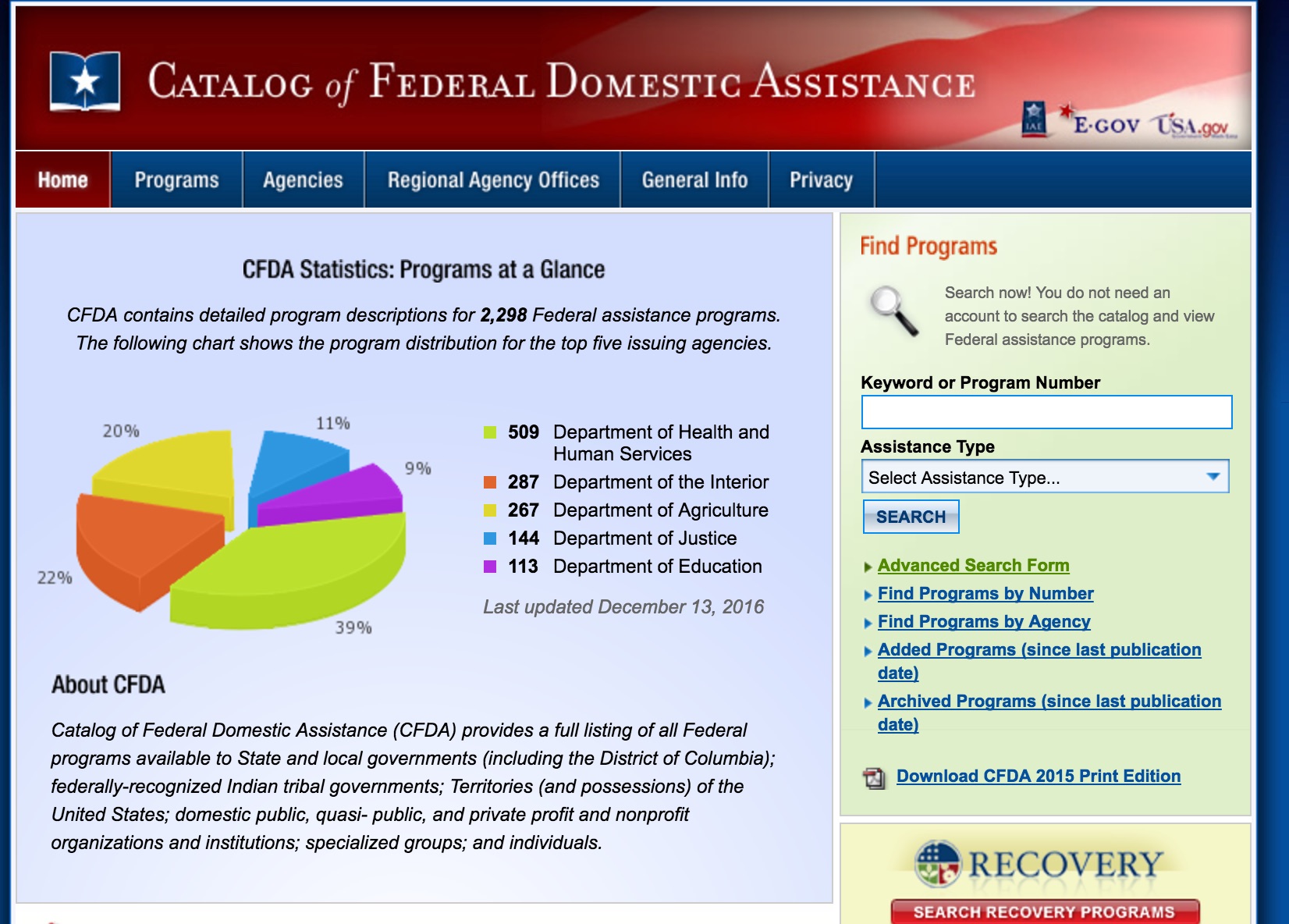
Seems like a good place to cut spending => where the Feds are just giving away money.
https://www.cfda.gov/
The pdf download to describe these programs is 3,277 pages long.
https://www.cfda.gov/downloads/CFDA_2015.pdf
the market responds
Stocks up, dollars up, gold and oil down, sounds like we should keep the #governmentshutdown
— Brooks Imperial (@broimp) October 1, 2013
behavioural law
In the search for the right college experience for our son, we took the opportunity to visit The King’s College in New York. We sat in on Dr. Parks’ 3rd year class, “American Political Thought & Practice II: 1825-1914.”
Dr. Parks lectured on the period immediately following the Civil War with focus on the major constitutional and statutory acts defining the legal bounds for granting former slaves full participatory citizenship in the United States. The Civil Rights Act of 1866 demonstrated the magnitude of this task, one so large that the 14th and 15th Amendments followed close on its heels. In an analysis of the language of the above act, Dr. Parks made the point that this new law conflicted with the majority of sentiments about former slaves. Slavery was abhorrent, but full equality under the law was quite another matter. The 13th Am. declaring slavery to be unconstitutional was an easy call. What you do with that conclusion, however, involved changing long held attitudes that didn’t change so easily.
As a result, the law was written to foreclose loopholes and specify penalties for disobedience.
Dr. Parks’ historical constructions flowed quite plausibly, the students who responded to his questions did so substantively, and the class was well-knit. His lecture was definitely the bright spot in our evaluation of The King’s College, which we’ve since concluded is not the right fit for our son – at least at this evaluation point.
On the narrow point, however, of the structure of laws designed to alter behavior of a hostile recipient audience, his observation was brilliant and worth expanding upon.
It doesn’t take a lawyer to recognize when straightforward legal language expresses basic law that comports with moral values and ethical behavior. “Congress shall make no law respecting an establishment of religion[.]” Simple and to the point.
Like post Civil War reconstruction laws, however, most modern statutes and regulations contain seemingly interminable clauses about exceptions, penalties, entrapments, alternative restatements of the subject, etc. Like reconstruction law, they fall into the category of behavior-changing impositions on a resistant populace.
The modern role of law is deterministic. It proceeds from the assumptions that behavior can be, should be, legally determined. But the adversarial structure of most modern law – language designed for enforcement against an unwilling populace – refutes any higher noble purpose and instead, indicates the futility of regulatory law by its distance from behavioral norms.
The Civil Rights Act of 1866 could not change behavior on a subject that everyone agreed was abhorrent. Almost 100 years later the Civil Rights Act of 1964 was still working to change attitudes about race. Law, evidently, is a poor vehicle for implementing change.
If modern law was really so self-evidently good for us, it wouldn’t need to be constructed to trap every imaginable means to circumvent it!
Our Constitution was not written with penalty clauses for disobedience. Citizens are not stupid. The United States started from this premise. The Founders built a government around express limits to what that government could legally do.
The progressive approach to governance, however, has the relationship between man and state completely turned around. Law is the progressive’s change agent for imposing a regulatory statist vision. Constitutions, equitable norms, and legal traditions don’t apply to progressives. They’re quaint devices for controlling the chumps.
The sooner citizens wake up and begin treating our regulatory dictatorship with the contempt it deserves, the better.
The progressive utilitarian belief in the power of law won’t magically make the law into an effective change agent, however, the foreseeability of failed progressivism will be of small comfort to Americans as we witness our elite progressive rulers side-step into heavy handed dictatorship.
B_Imperial