commuting in Bangkok

Commuting across the Chao Phraya river in Bangkok

Chao Phraya River, BangkokBangkok bikespolitical situation

———————————————————————– (more…)

no easy answers

Candidate Robert Thomasson

advocates “Smart Growth” for Elbert County, an “urban planning and transportation theory that concentrates growth in the center of a city to avoid urban sprawl; and advocates compact, transit-oriented, walkable, bicycle-friendly land use.” It’s difficult to imagine “walkable, bicycle-friendly” corridors that would be practical over the distances in Elbert County.

Candidate Andy Wyer

believes “managed growth is designed to preserve the rural life style and quality of life that we all enjoy in Elbert County.” “Growth management is a set of techniques used by government to ensure that as the population grows that there are services available to meet their demands. These are not necessarily only government services. Other demands such as the protection of natural spaces, sufficient and affordable housing, delivery of utilities, preservation of buildings and places of historical value, and sufficient places for the conduct of business are also considered.

One technique is the imposition of impact fees. Impact fees are imposed to charge the owners of newly developed properties for the “impact” the new development will have on the community. Fees can be used for such things as transportation improvements, new parks, and expansion of schools. Impact fees are not used to maintain existing facilities, but instead are used to create new facilities in proportion to the number of new developments in the area.

Another technique is application of zoning to reduce the cost of service delivery. Zoning can be used to reduce the area affected by urbanization, allowing the same number of people to live and work in a smaller area, allowing services to be delivered more efficiently. For example, grocery stores and pizza delivery businesses can service only a limited area. If more customers are located within their service delivery area, the cost of delivering their services is decreased.

Preventing suburban densities from affecting a large area also has the effect of providing open spaces so that people who wish to live in a rural setting can do so without urbanization threatening their lifestyle.

The application of growth management techniques are often governed by the development of a comprehensive plan. The plan can be used to measure the impact that new growth will have on the community and define the method by which that impact is mitigated.”

Candidate Steve Valdez

would “plan and manage Elbert County’s growth with smart and proven policies.”

Candidate John Shipper

would “plan and manage growth compatible with a rural lifestyle.”

Put Mr. Valdez and Mr. Shipper in the “managed growth” camp with Mr. Wyer.

All this planning chutzpa begs a great big question. What have managed growth and smart growth planning theories accomplished in Elbert County to warrant such devotion? Answer: nothing – not a damn thing.

Elbert County town centers have minimal economic activity. The Elbert County Fair gets smaller each year. Our road network is in poor condition and does not promote efficient transits of the county. Our schools are producing historically low performance measures, enrollments are shrinking, teachers are leaving, and students are fleeing to Douglas County schools. Commercial enterprises have been closing faster than they are opening, and landowners are prevented from engaging in development that could bring economic returns to the county. Economically, Elbert County is hobbled, and at least four commissioner candidates, apparently, like things that way.

We don’t need their focus on the past, their myths about the rural life style and quality of life that need preserving. This quality of life is not worth preserving. It is poor and getting poorer.  Oh, if you happen to work on or live near one of John Malone’s preserved ranches things might appear to look good, but that’s not because of anything produced here.  The hobbies of one wealthy man don’t constitute a local economy.

We can and must build a much better quality of life with better infrastructure, efficient transportation corridors, desirable schools, businesses that produce goods and services for commercial markets, and opportunities for citizens to participate in economic growth. But these candidates, their myopic visions, the controls they would impose on us, and their master plans, will produce nothing. Elbert County needs opportunities of the sort that county government and Malone’s charity cannot produce. We have to do the hard work ourselves to build these things.

Elbert County citizens need to stop lapping up easy answers from planners. Master plan devotees have had over a decade to prove their worth in Elbert County and they failed miserably. New smart-growth and managed-growth master plans are no more than new lipstick on an old pig.  They are not the answer. There are no easy answers.

Plan metrics

Some species covered, not man

Void for vagueness

Void for vagueness is a legal concept in American constitutional law, whereby a civil statute or, more commonly, a criminal statute is adjudged unconstitutional when it is so vague that persons “of common intelligence must necessarily guess at its meaning and differ as to its application,” as the United States Supreme Court articulated in Connally v General Construction Co., 269 US 385, 391 (1926). A statute is void for vagueness when: 1) it is unclear what persons fall within its scope, 2) what conduct is forbidden, and/or 3) what punishment may be imposed. Due process requires that a law be reasonably definite as to what persons and conduct are covered as well as the punishment for any violation. In determining whether a law is void for vagueness, courts have imposed the following tests: 1) does the law give fair notice to those persons subject to it? 2) does the law guard against arbitrary and discriminatory enforcement? and 3) can the law be enforced with sufficient “breathing room” for First Amendment rights?

July 6, 2008

It is difficult to see how a planning document that did not pass this test, could be constitutional and enforceable. Regarding the Transportation Master Plan:

Remove all intangible, vague, uncertain, subjective, ambiguous, duplicitous, parse-able expressions that can be twisted into subjective meanings, value-laden, and emotional language from the plan. If it’s not definite, or if it can create grounds for future disputes, or if it is arguable, or if it is based on contested science, it shouldn’t be in there.

The document is supposed to be about transportation. Make it ONLY about transportation. Cut all the lip service and happy language out. That stuff will only foster divisions that will tie people up and detract from the transportation mission.

“Transportation” is a solvable problem. There is a least-cost, maximally efficient, solution for any transportation network. A transportation plan should be so targeted. It should not be loaded up with non-transportation objectives. It should not be a vehicle to advance a subset of politics.


Transportation Plan

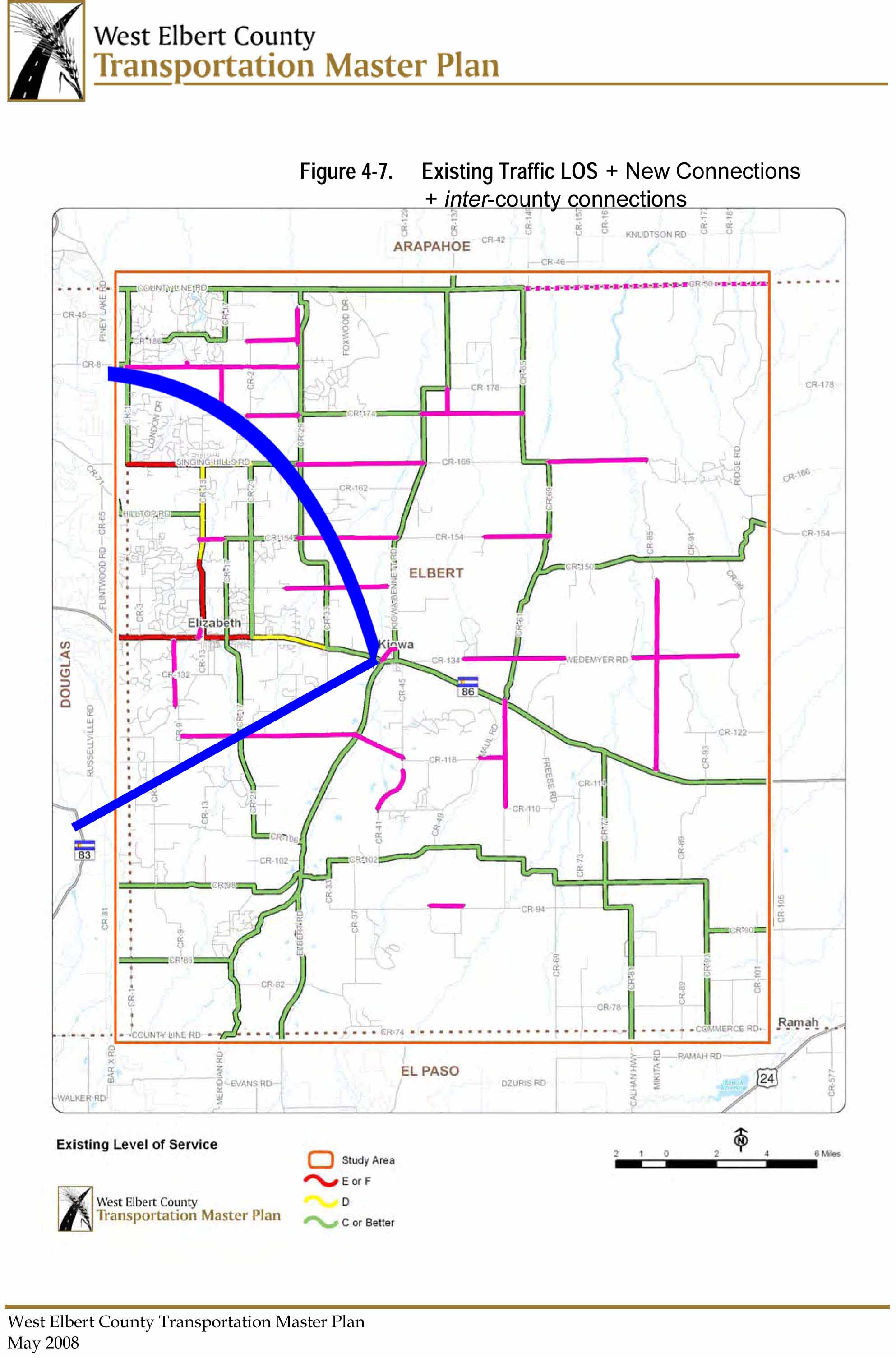
This image is a merge of the “existing level of service” and “new connections” graphs from the transportation master plan, plus two diagonal connections that would improve inter-county transit times.

(click to enlarge)

Transportation plan, existing level of service, planned new connections, unplanned diagonal connections needed

1) The great majority of new connections are East-West routes within the county.

2) North-South routes don’t change much.

3) There are no new connections to points outside Elbert County.

It appears fair to conclude that the plan would facilitate intra-county transportation, but not inter-county transportation with our neighbors. Therefore;

1) The plan is not designed to bring this portion of Elbert County into a more integrated regional transportation network and appears to violate the purpose of creating a component of a larger regional transportation plan construct.

2) The plan does not promote economic integration between this portion of Elbert County and its’ three neighboring counties.

3) By not improving linkages to surrounding counties the plan preserves the economic isolation of Elbert County from neighboring counties. This indicates that the “socioeconomic trend” in this section of Elbert County is to remain a bedroom community. The plan’s intent to spend $1.5 billion dollars to build out and pave road infrastructure seems inconsistent with economic isolation.

transportation master plan draft

West Elbert County Transportation Master Plan May 8th Draft
West Elbert County Transportation Master Plan May 8th Appendices

These documents are available on the county web site. I saved them here in case they get removed from the county site.

On the whole, it looks like the plan creates more beneficiaries than those negatively impacted. A good deal of property stands to be reallocated to transportation, however, and the plan would gain considerable authority if it were put before the voters for adoption. Whichever way the vote went, many fights would be avoided.

I’m a little surprised the plan did not propose any major diagonal arterials into the Springs and Denver to facilitate commuting. A great way to “foster the rural quality of life so important to Elbert County citizens” (Community Vision Statement, pg. 3-5.) would be to have those citizens spend less time on zig-zag roads commuting to and from town.

buyers remorse

Please fix our roads Mr. Taxman

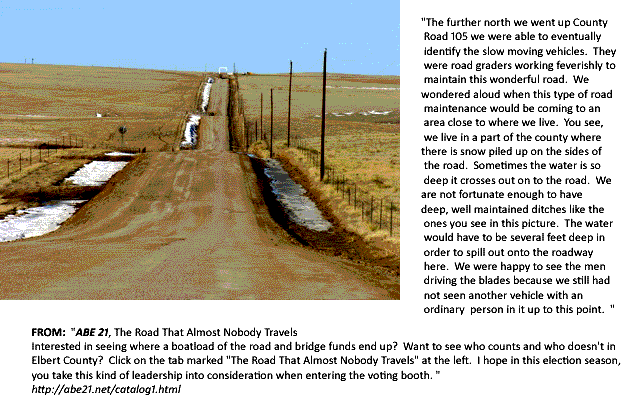
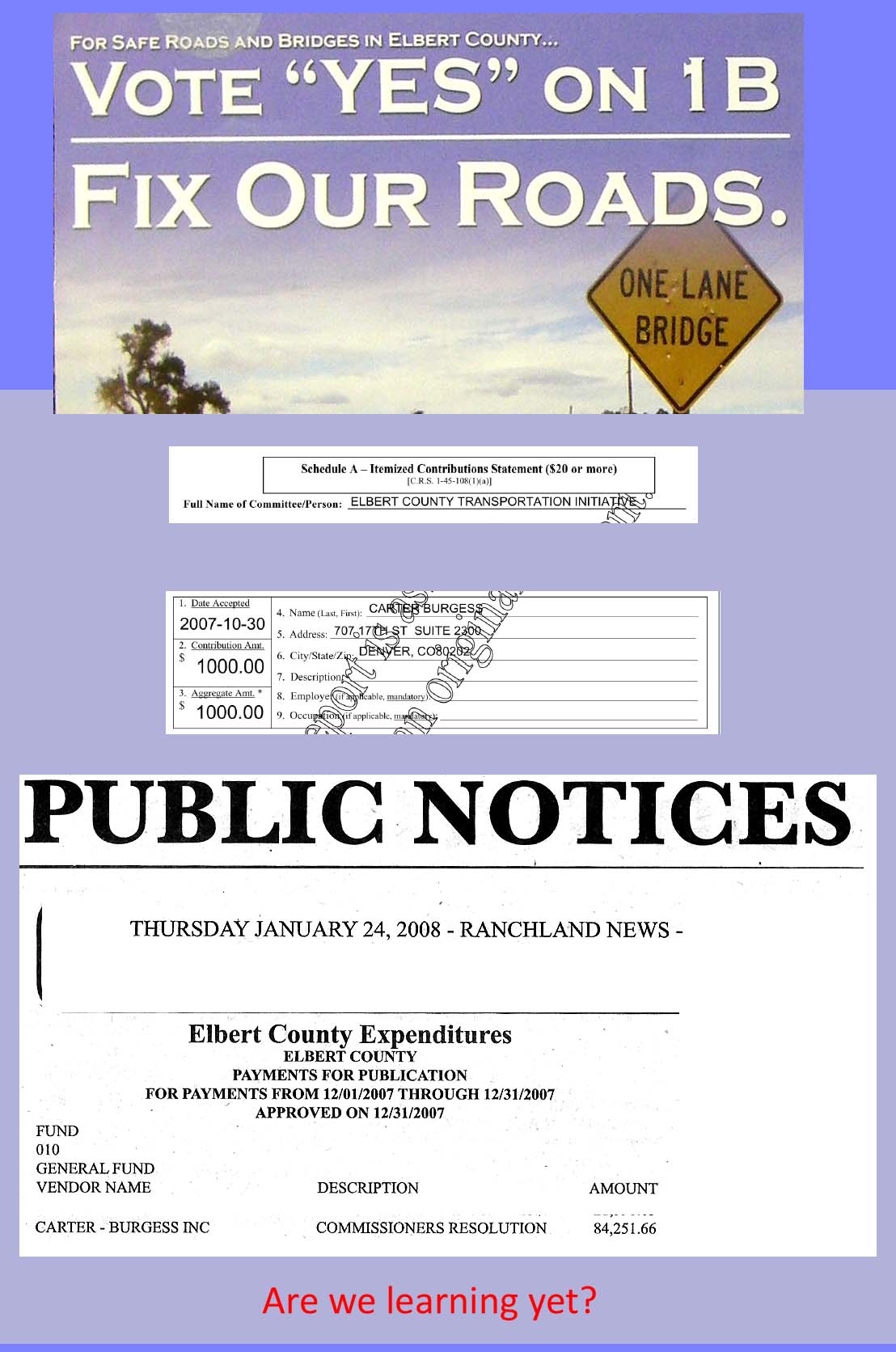
Mr. Happel’s words about the necessity for safety’s sake of fixing Elbert County road berms still ring in my ears. The Thomasson’s supported the tax too, and now resent the tax being used in the same way, almost down to the same picture (!!) as it was sold.

Tax buyers remorse

(click on images to enlarge)

They gave the county a blank check forever, the county did exactly what it was told to do, and now they’re whining about it. Perhaps worst of all, the chance they will learn from this expensive lesson is approximately zero.

the beet goes on

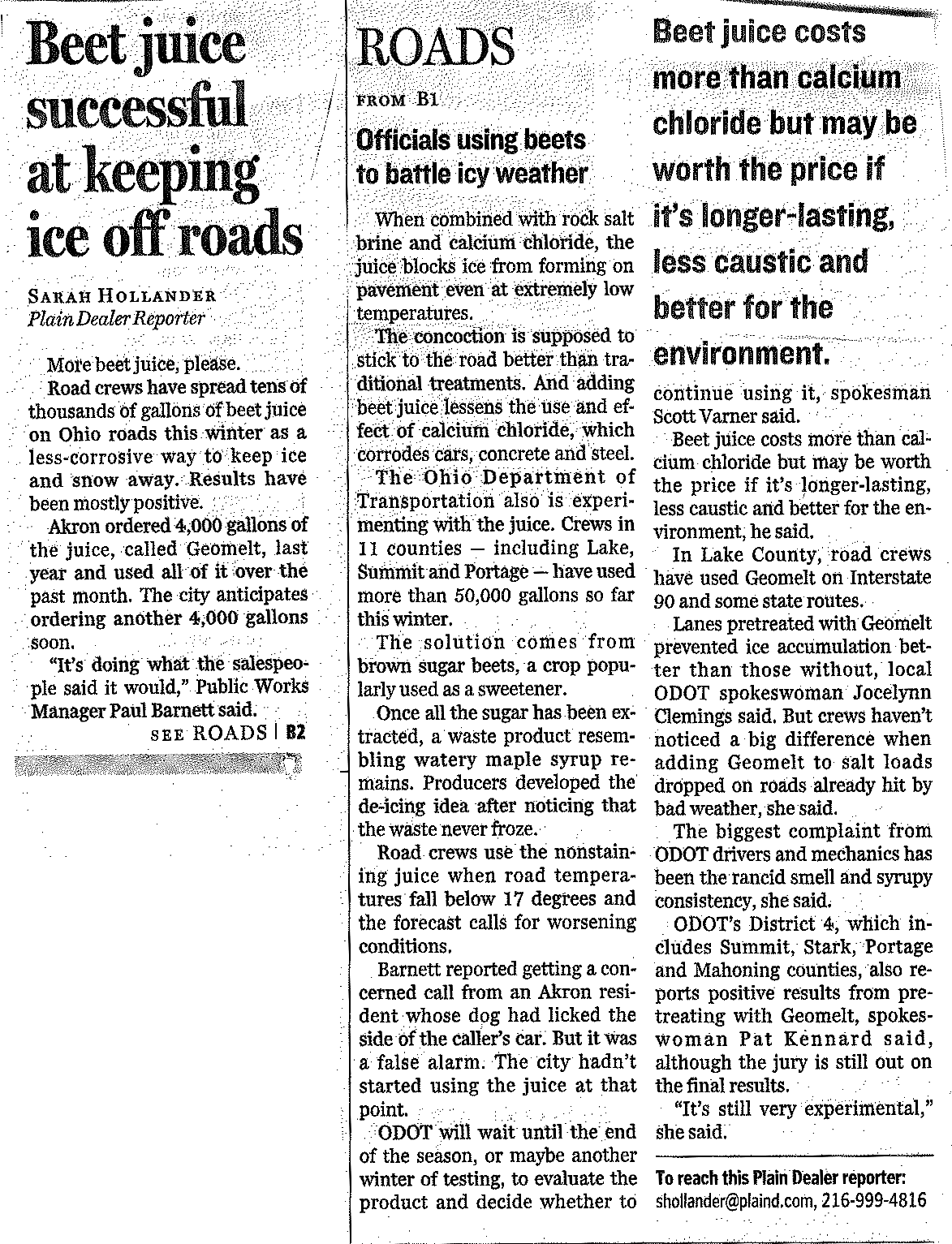
The Beet Goes On

.

.

.

.

.

are we learning yet?

Are we learning yet?(Click to enlarge)

.

.

.

.

.

.

tran master plan update

Notes from the transportation master plan meeting of 10/29/2007

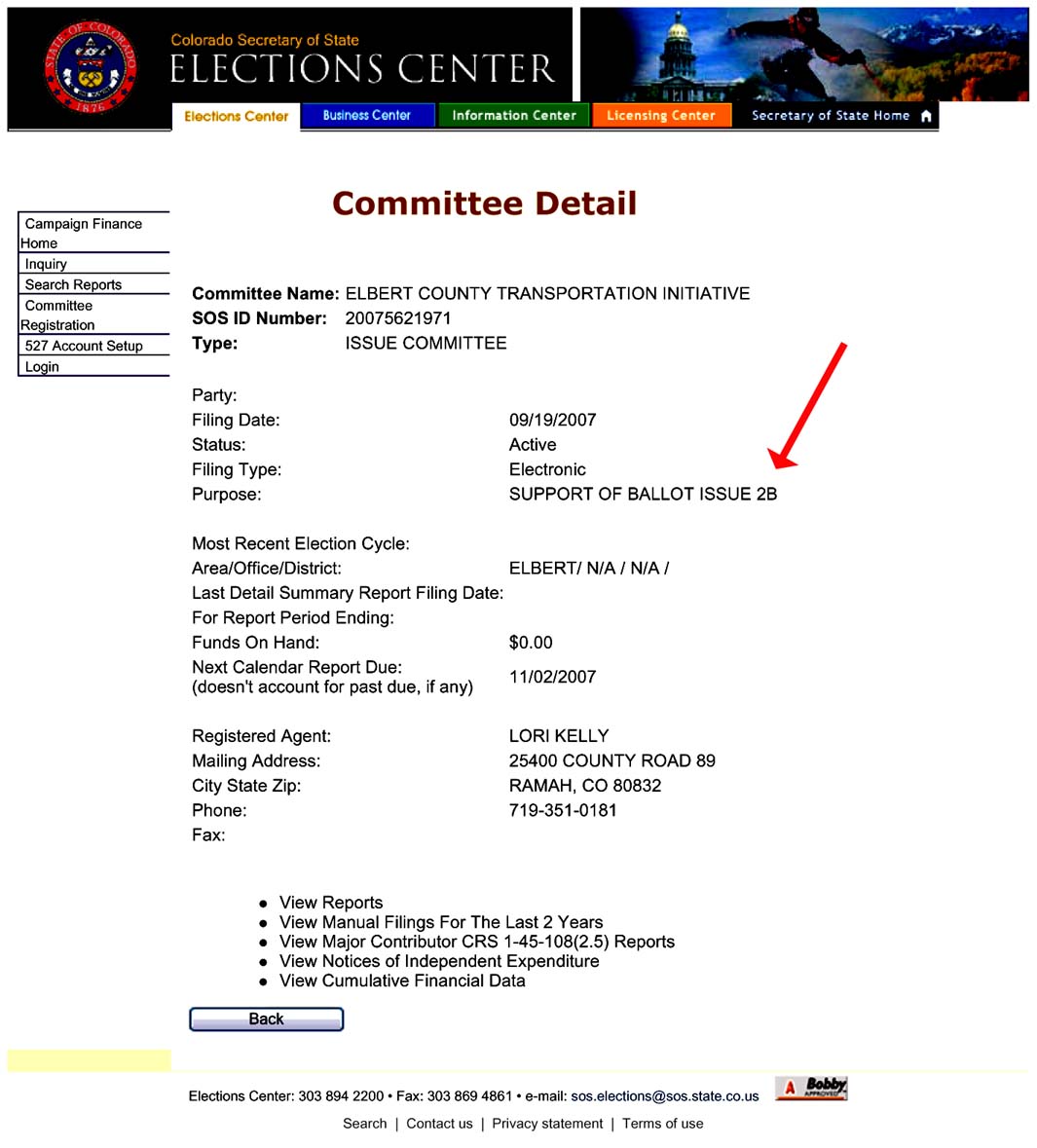
2B or 1B? That is the question.

(click to enlarge images)

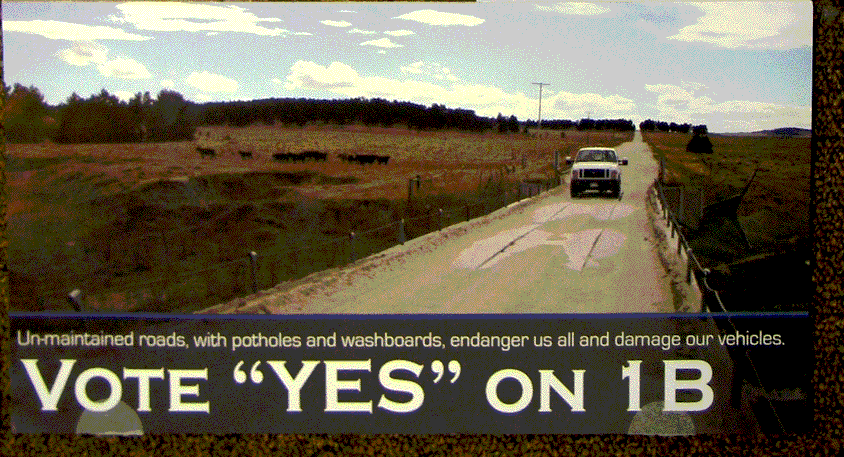
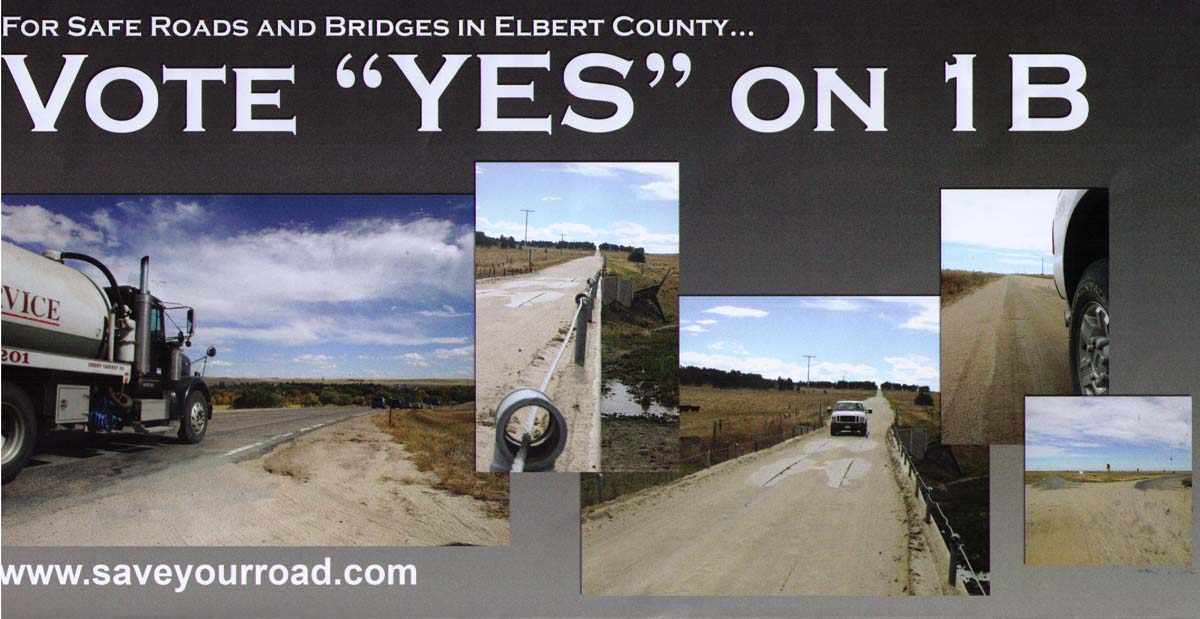
1B Flyer 

Are one-lane bridges in eastern Elbert County with minimal traffic a priority here?  If 1B passes, that’s not where the money will be spent.  Nor should it be, however, those images which represent a small fraction of road conditions in Elbert County are a much better sell.

SOS RegistrationSo who paid for the 11″ x 17″ glossy flyer sent out by the Elbert County Transportation Initiative?  And how come no one’s home at www.saveyourroad.com?

Before you buy the “public safety” argument in favor of 1B, you should see; 1) evidence of harm caused by poor roads, 2) the value of that harm, 3) evidence that similar harm will probably occur in the future if the road isn’t fixed, 4) evidence that the road can be fixed to prevent future harm, and 5) a commitment to allocate tax funds to that specific problem.  

Tax 1B contains none of this information.  It’s a blank check. 

trans plan mtg of 9/17/07

Summary Notes of Elbert County Transportation Master Plan Public Meeting of September 17th, 2007
 
Richard Miller, Elbert County Planning Director introduced members of his staff who were in
attendance as well as Commissioner John Metli. Elbert County staffers who attended were:
Carolyn Parkinson- Elbert County Planning Dept.
Rick Manyik- Elbert County Road and Bridge Superintendent
Denny Van Why-Elbert County Office of Emergency Management
 
Richard introduced the team from Carter & Burgess:
Karen Stuart- Municipal and County Services Specialist
Scott Jones- Transportation Planner
Misty McCoy- Environmental Planner
 
This meeting was held in the Elizabeth Middle School. There were about 40 people in attendance. (more…)

strange bedfellows

Going protectionist over a fantasy highway

Xenophobes see a threat to U.S. sovereignty in a Texas freeway project that would ease trade with Mexico.

By Shikha Dalmia and Leonard Gilroy  September 20, 2007

With respect to conservatives, each one of the following ad hominem abusive adjectives was used in the above linked story:

paranoid, isolationist, jihad, sinister, xenophobes, apoplectic, paranoid rantings, protectionist fringe, hysterical, atavistic, ideologues of fear

This article is about Ports to Plains, a subject in which the TRW claim expertise.

Necessity makes for strange bedfellows though.  The above authors are affiliated with the Reason Foundation, a group of Libertarians that a couple of TRW Democrats would probably find disagreeable.

As for Dalmia and Gilroy of the Reason Foundation, their opinions might be more persuasive without the ad hominems, and with a lot more “reason.” 

traffic counts

(more…)

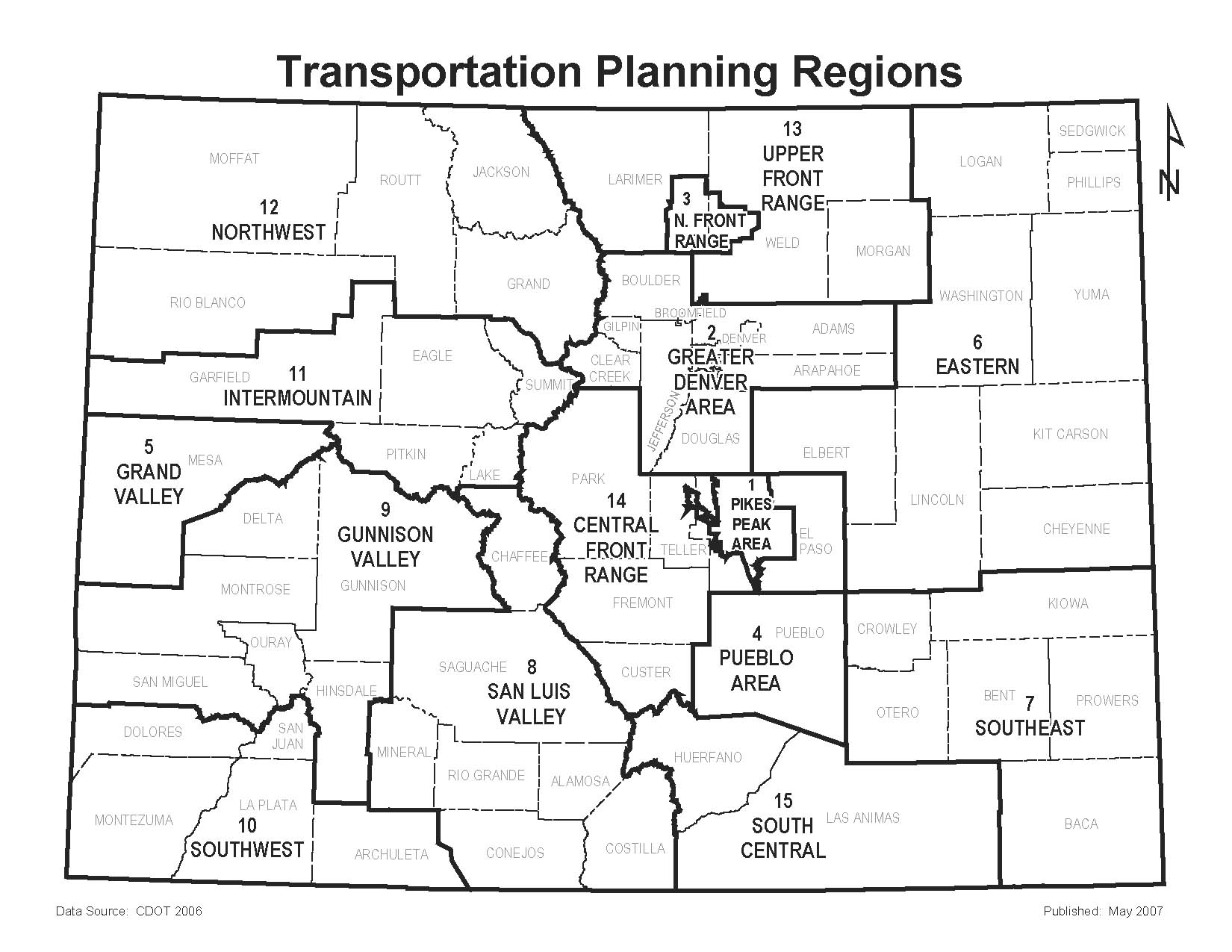
CDOT planning regions

(more…)

transp mtg 8/16/07

(more…)

Search

Blogroll

Categories

Archives

Meta