Notes from the transportation master plan meeting of 10/29/2007
1B complaint
sales tax passes
The 1B sales tax passed, 2904 to 2694, or 51.9% to 48.1%. Term limit extensions went down by a larger margin.
I’ll bet anyone a hamburger that the tax&spend Republicans will be back to the voters next year looking for more money.
See: Trouble in Paradise “The sales tax is in direct opposition to the Elbert County Republican Platform and it puts a burr in the chaps of the fiscal responsibility types who want no taxes whatsoever. The other side realizes that the county finances have been so badly mismanaged that they have to do something or the voters are going to go through the ceiling about the abysmal state of the roads. You can’t find a democrat to blame for this one boys and girls.”
Maybe so, maybe not, however, the juxtaposition of “fiscal responsibility” opposite “pro-tax” speaks volumes.
pro-[sharia/left] activism
NYTimes on Pakistan lawyer demonstration “The pressure on the lawyers is far more intense now than it was even in the spring, when their anger had been stoked by General Musharraf’s attempt to dismiss the chief justice. The step was seen as a direct threat to the independence of the judiciary, and hence themselves. Led by Aitzaz Ahsan,…
Aitzaz Ahsan is an active member of Pakistan Peoples Party. “Among the express goals for which the Party was formed were the establishment of an egalitarian democracy and the application of socialistic ideas to realize economic and social justice.
The Life Chairperson – Pakistan Peoples Party Benazir Bhutto
Pakistan Sharia Law “The Enforcement of Sharia Act 1991 affirms the supremacy of the sharia, (defined in the Act as the injunctions of Islam as laid down in the Holy Quran and Sunnah) as the supreme law of Pakistan. The Act states that all statute law is to be interpreted in light of the sharia and that all Muslim citizens of Pakistan shall observe the sharia and act accordingly.
.
Why is the NYT so sympathetic to the Pakistani sharia left? The NYT wouldn’t even exist if the sharia left controlled America.
misplaced faith
(click to enlarge)

No foundation in law or natural rights exists to make third parties liable for existing infrastructure deficiencies. Moreover, regardless of how “responsible and fair regulations” are, the county has no regulatory authority over private mineral rights, including groundwater. This is not to say that such resources shouldn’t be carefully husbanded to maximize their utility, or that the pristine nature of our surroundings shouldn’t be protected. Government, however, is probably the last place I would look to protect such valuables.
1B facts
Norm, Norm, Norm. Normally I don’t respond to ad hominem attacks [ Questioning integrity Ranchland News 11/1/07 ] but this time I will because I like you a lot.
First:
RE: “First, I must question the integrity of this committee, which in turn questions the contents of their flyer.”
See: http://en.wikipedia.org/wiki/Ad_hominem “An ad hominem argument, also known as argumentum ad hominem (Latin: “argument to the person”, “argument against the man”) consists of replying to an argument or factual claim by attacking or appealing to a characteristic or belief of the person making the argument or claim, rather than by addressing the substance of the argument or producing evidence against the claim. The process of proving or disproving the claims is thereby subverted, and the argumentum ad hominem works to change the subject.
It is most commonly used to refer specifically to the ad hominem abusive, or argumentum ad personam, which consists of criticizing or personally attacking an argument’s proponent in an attempt to discredit that argument.”
Questioning the integrity of this committee [ OCC registration ] in no way questions the contents of their flyer [ OCC flyer ].
Second:
RE: “The ballot is quite specific the revenue from sales/use tax will be spent only for Capital Improvements, which includes hard surfacing roads among other capital improvements.”
See:[ County Sales Tax Ballot ] The ballot measure actually says that funds will be applied to “road and bridge capital and operating expenditures.” The measure actually uses that language twice, once to name the fund and a second time to describe how the fund will be used. Also, the measure does not in any way define the substance of capital expenditures, or the split between capital and operating expenses.
The measure is a blank check.
Third:
RE: “They state that Douglas County sales tax is 10 percent. A call to the Douglas County confirmed the county sales tax is 1 percent[.]”
See: [ Colorado Sales and Use Tax Rates ] If you add up all the sales and use taxes in Castle Rock and/or Parker, you get somewhere between 7.5% and 8.0% currently in effect. Looking at the 2007 Douglas County ballot (see: [ Douglas County 2007 ballot ] ) you will find existing sales taxes continued, new sales taxes proposed, and a variety of proposed property taxes.
A rough estimate of 10% is reasonable.
Fourth:
RE: “TABOR prohibits the commissioners to increase the county budget by more than 6 percent per year even if the funds were available – refer to TABOR.”
See: [ County Sales Tax Ballot ] 1B says that funds may be collected and spent without limit “under Article X, Section 20 of the Colorado Constitution [TABOR] or any other law[.]”
This is a “de-bruced” measure, exempt from TABOR limits.
Fifth:
RE: “It is one thing to be critical, but not to offer two or more solutions to improving our county transportation system is beyond apprehension.”
Pro 1B arguments have ignored dramatic and on-going revenue growth in the county budget over the last decade, and have failed to ascertain why these additional millions have not led to the desired end they seek of improving road conditions. Each year, Elbert County collects additional millions in revenue, yet now, these particular additional millions will fix things.
I don’t think so my friend.
Sincerely, Brooks
regulation man
“Innovation is the source of our progress. It is the cutting edge of the ever larger fulfillment of our aspirations. By attacking innovation, Regulation Man attacks tomorrow’s range of choice as well as today’s. By attacking an expanding technology, he attacks our capacity to solve tomorrow’s problems. All of this is done in the name of maintaining standards. We also lose choice when we surrender to bureaucratic agencies the power to make law. Our ability to influence legislation and to exercise some choice in it is very small even when laws are made by our representatives in open debate. This, by itself, is a powerful argument for minimizing the intervention of law into our lives. “The liberty of the subject.” said Thomas Hobbes, “depends upon the silence of the law.” By giving regulatory agencies the power to make detailed rules at will under very broad guidelines, we are surrendering even that vestigial element of control.
Of all of the laws to which we are subjected each year, only a very few are now made openly by our representatives, subject to some degree of public influence. Most emerge from the regulatory agencies as rules which have the full force and sanction of law. This is not only undemocratic; it is uncontrollable. Each agency rolls forward under its acquired momentum, propelled no longer by the will of the people but by the whim of the bureaucrat. The rules and innovations are not subject to full debate and Congressional approval: we are left with the rare and occasional power of specific Congressional veto, a power which can only be exercised after a vast time-consuming and heroic effort.
In many of the works of Regulation Man, the attention given to visible victims leaves the plight of the invisible victims unknown and unlamented. But when we add to all of those consequences the loss of our power as citizens to influence the rules which confine our behavior and restrict our choices, we can finally see the shape and the name of two of those previously unseen. The lesser of them is called democracy, and the greater one is called liberty.”
From: Regulation Man and the Invisible Victim By: Madsen Pirie
cedar point wind project
(click to enlarge)

.
.
.
.
.
morning 10/30/07


.
.
.
.
35 inconvenient truths

smart growth
“Smart growth” is planning-speak for urban development, based on the principle that people should live in high-density, automobile-free, environmentally-minimal, urban centers. It tries to convince people they should want less rather than get more. Most people, however, want more. This is not a moral judgment. It’s just our nature.
In America most people migrate away from compartmented lives toward open spaces and freedom. The young start out renting in the cities and dream of the day they can reside in their own detached family structure. After building equity on that achievement they move up and out to the suburbs for more space. And then they keep going as far as they can to larger, more natural, more private spaces. At the top of the heap they buy small islands and large ranches in the West.
None of us escapes the fundamental economic principle of scarcity Our human nature is to have unlimited wants and limited means. And though our great country was built by humans who freely adapted and thrived in this construct, “smart growth” planners no longer trust us to find our own, best, natural economic balance. Instead, they dictate what our needs ought to be, and then they design the parameters of our lives so that we may some day rise to the limits they have predetermined.
They use government coercion to enforce zoning laws and we bear the burden of their communitarian vision of the greatest good for the greatest number. They’re not content with the tools available to non-bureaucratically-empowered citizens. Let the citizens have their constitutionally protected speech, their powers of persuasion, and their free choice. Let them squawk, “we” have the zoning laws.
Elbert County is full of people who migrated up and out of urban and suburban pasts. And why would they want to return to suburbia? That’s where they came from. Of course it’s a less attractive life to those that already live here. But to those on the other end of the spectrum desperate to escape the confines of the city, suburbia is a shining city on the hill. Are their fundamental rights any different than our own?
The crushing load of zoning legalese and politicking that the 20th century planning movement produced have not solved a single economic problem. They haven’t made people more happy, more healthy, more wealthy, or more wise. Rather, these bureaucracies have siphoned off and wasted untold amounts of scarce human energy in the fruitless pursuit of a mythical great society.
Get real people. Determinism never solved anything. We need to unleash human creativity to solve real problems, not enslave it to the code of a monolithic state. Elbert County won’t solve it’s water scarcity or preserve it’s quality of life through planning and zoning. Skilled lawyers create arguments to achieve any purpose under any set of circumstances and any set of laws. That is the nature of our language. Planning is, quite simply, a legal venue for third parties with no stake in our lives to control us. Planners have had decades to prove that planning works, yet the problems stay a step ahead of them. We should leave this relic of 20th century progressivism in the 20th century and move on.
Brooks Imperial
(click to enlarge)

.
.
.
party trumps chumps
TRW, October 07


.
.
.
.
.
TRW, August 07
“Elbert County does not have a sales tax, but our commissioners will ask for one in November. Their reasoning is that the Elbert County Road and Bridge Department needs the money to, you guessed it, repair and maintain Elbert’s woeful system of roads. Unfortunately, the board of county commissioners is the very group that has been shifting money out of the road and bridge department for other projects that caused gross deficiencies in the first place. In what can only be described as a move that demonstrates shortsightedness, Elbert’s commissioners say that if the tax increase passes, all of the money will be earmarked for road and bridge. Before you start calling us hypocrites, understand that if this money is put toward that department, there is no way to get it back into the general fund without breaking the law. Lord knows the road and bridge department is a deserving group, but it is irresponsible to put all of the money from a tax increase into a place where the money can’t be used when emergencies occur. We do have emergencies from time to time.”
However you parse it, the lure of public money overcame their disdain for the BOCC.
government advocacy?
—–Original Message—–
From: B.I.
Sent: Thursday, October 25, 2007 12:17 PM
To: JH Schroeder
Subject: Funding pro-1B flyers
In the 10/25/07 ECN paper the Thomassons allege;
1) the pro-1B flyer cost $38K, and
2) the ECDC paid a portion of that expense, and
3) the ECDC receives funds from the BOCC.
If these allegations are true, the non profit ECDC may fall under a “strict construction” of government councils proscribed by C.R.S. 1-45-117 from funding issue advocacy in an election.
att. C.R.S. 1-45-117
“The purpose of this section is to prohibit the state government and its officials from spending public funds to influence the outcome of campaigns for political office or ballot issues. Colo. Common Cause v. Coffman, 85 P.3d 551 (Colo. App. 2003), aff’d, 102 P.3d 999 (Colo. 2004).
“This section must be strictly construed. It is an established principle that statutes regarding the use of public funds to influence the outcome of elections are strictly construed. Coffman v. Colo. Common Cause, 102 P.3d 999 (Colo. 2004).”
ignoble Nobel
Peace Prize Committee Disbands By William S. Smith : 19 Oct 2007 http://www.tcsdaily.com/article.aspx?id=101907A
“I always thought the peace prize was a bunch of crap given to whiney, self-aggrandizing, busybodies by a bunch of self-important, narcissistic gullible, retired, left-wing, Norwegian, gasbag politicos.” Senator Inouye
apolitical


tax flyer buyer

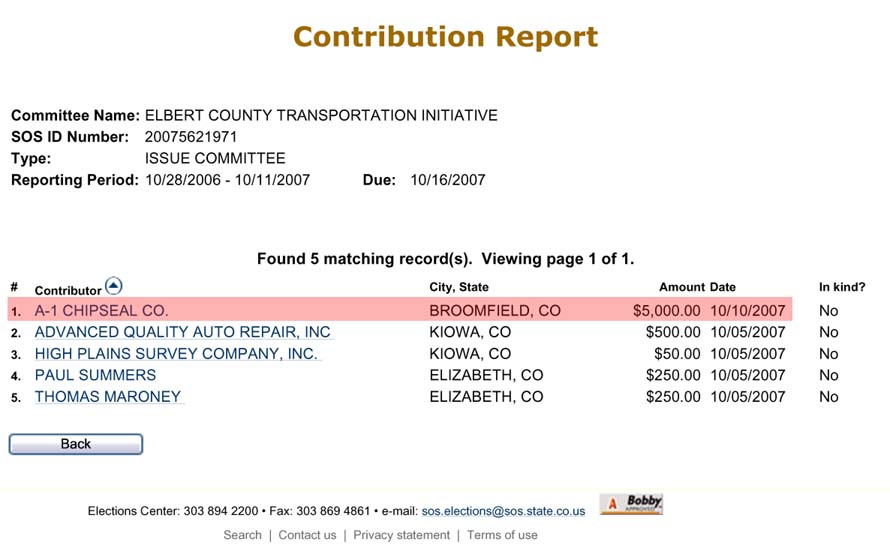
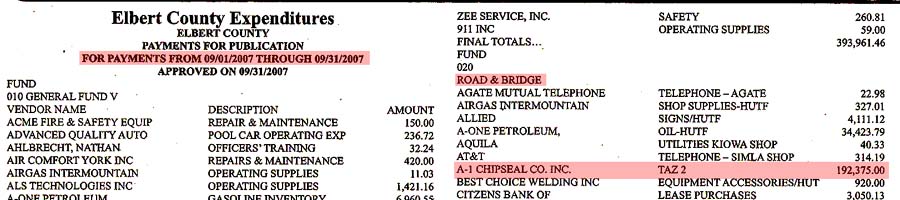
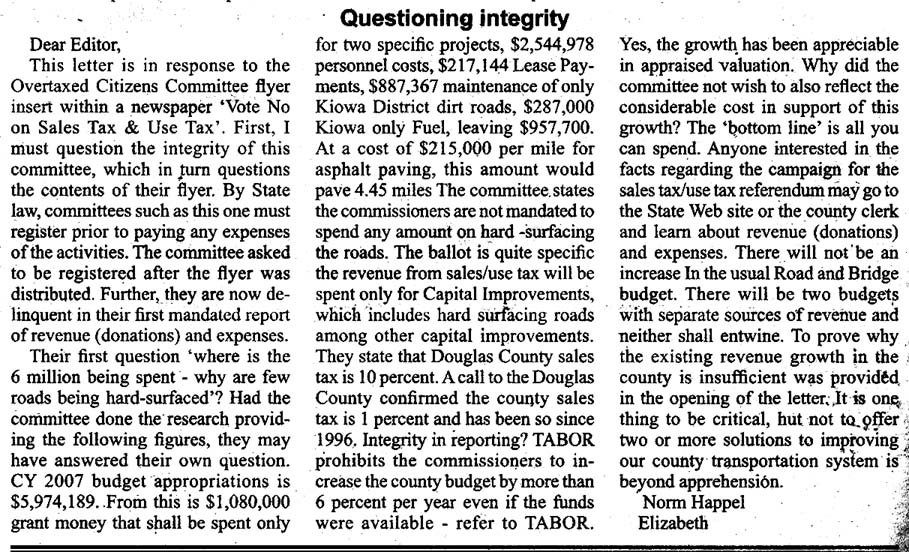
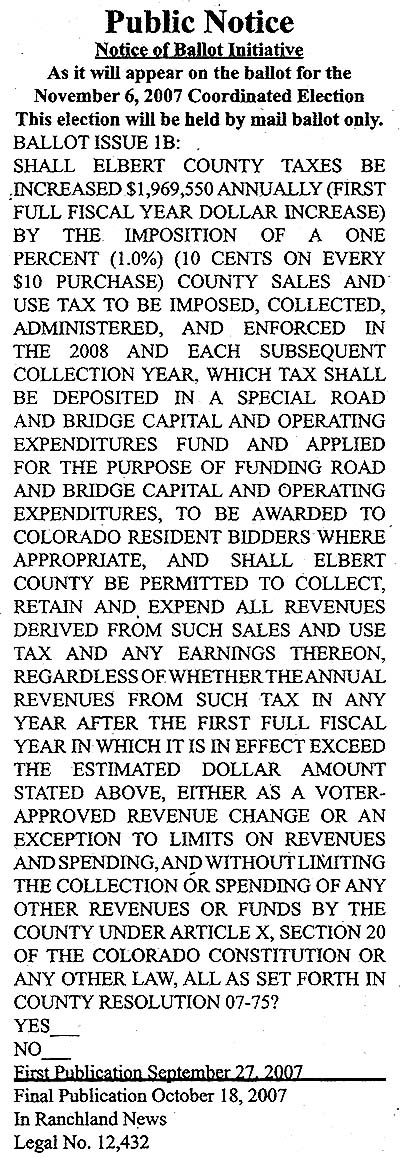
pro tax neighbors
(click to enlarge)
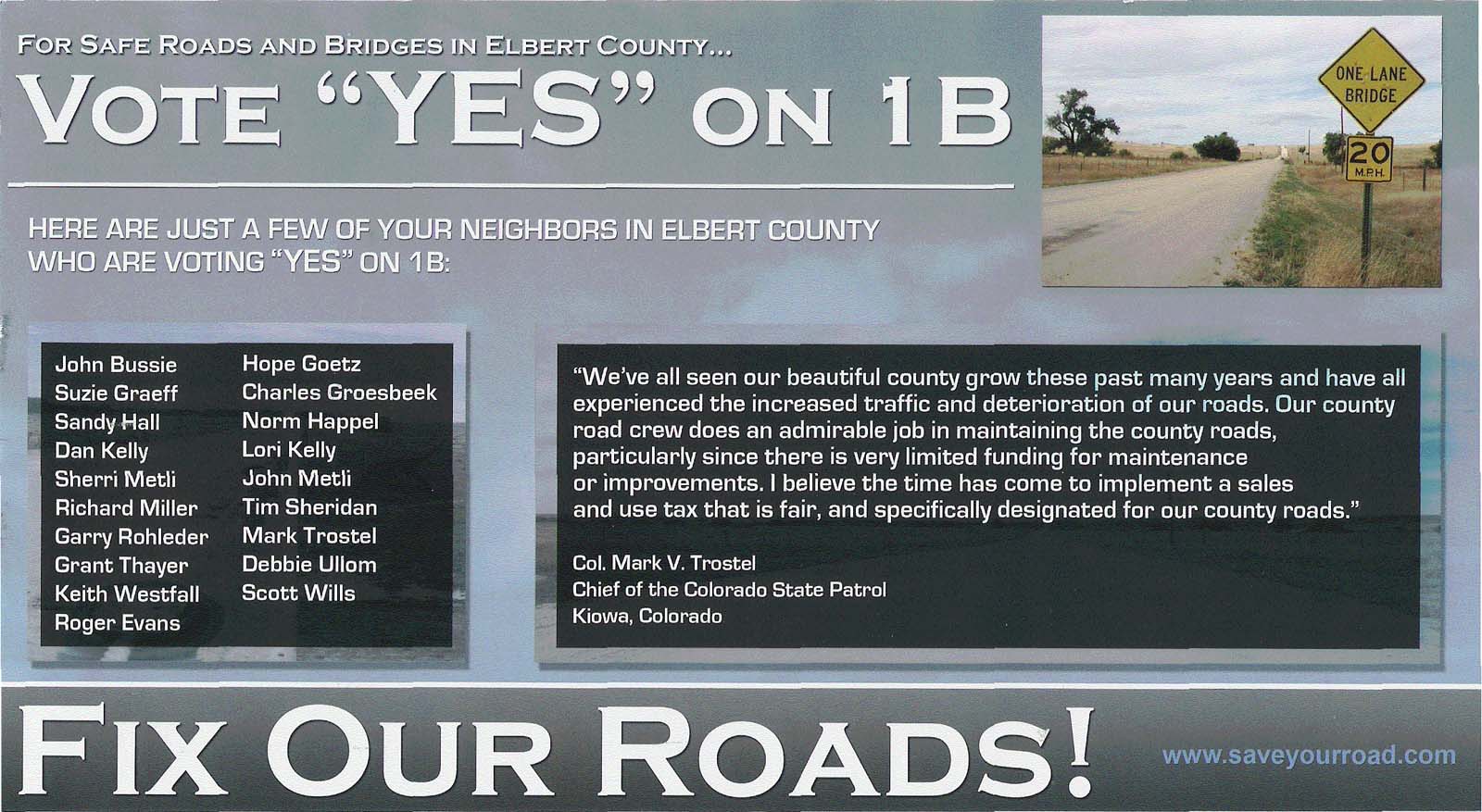
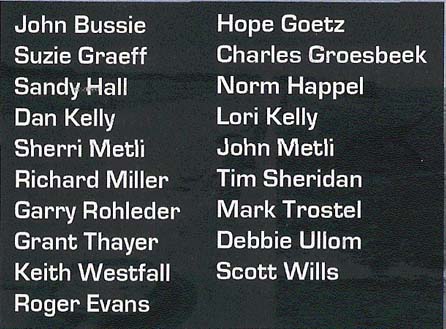
Remember the tax position of “your neighbors in Elbert County” next time they run for Elbert County Republican precinct committeeperson, district captain, party officer, or public office in a precinct caucus, county assembly, primary election, general election or vacancy appointment.
“We believe that good government is based on a system of limited taxes and spending.”
“Many Democrats, however, believe the government has a right to claim the money earned by working Americans.”
“The taxation system should not be used to redistribute wealth or fund ever-increasing entitlements and social programs.”
“High taxes and unreasonable regulations stifle new and expanded businesses and thwart the creation of job opportunities and prosperity.”
[smart = no] growth
Smart Growth Doesn’t Just Threaten Urban Areas
Recent reports from smart-growth groups have shown that their goals are not limited to reshaping American urban areas. They also want to impose their high-density, mixed-use visions on small towns while they freeze development in rural areas. [Read more…]
why planning fails
From: Who Are These Planners, Anyway?
By Randal O’Toole, The Antiplanner [excerpts]
. . .Utopianism and hubris would not be problems if planners and their architect gurus merely said to people, “Here are some ideas that will improve your life. Why don’t you try them out?” According to Peter Hall’s history of modern urban planning, Cities of Tomorrow [excerpt], most “of the early visions of the planning movement stemmed from the anarchist movement.”
. . .Sadly, most planners ended up following the authoritarian model. As Hall observes, “in half a century or more of bureaucratic practice, planning had degenerated into a negative regulatory machine, designed to stifle all initiative, all creativity.”
Yet I would argue that such authoritarianism is an inevitable result of the planning process. After all, if you have a vision of how people ought to live, and if you really believe that vision will significantly improve the world, then you don’t dare risk letting that vision be corrupted by the vagueries of the free market. So you turn to government to impose that vision on the world.
In sum, planners have historically believed that they could use urban design as a form of social engineering to perfect the world and the people in it. They acted on this belief by using the power of government to impose their designs through zoning and other regulations. The planning profession today continues to be shaped by these ideas.
October mornings


.
.
.
.