
humility

Human Nature Doesn’t Allow History To End

By VICTOR DAVIS HANSON
Posted 03/02/2012 06:53 PM ET

The European Union and the United Nations, as well as globalization and advanced technology, were all supposed to trump age-old cultural, geographical and national differences and bring people together.

But for all the high-tech veneer of the 21st century, the world still looks a lot like it did during the last hundred years and well before that.

After the Greek financial meltdown and the emergence of German financial dominance, Europe once more obsesses over the so-called German problem. Should Europeans admire the industry of the German people, or fear that such competency and drive — as in 1870, 1914 and 1939 — will eventually translate into German political and military supremacy?

The division of Germany, the common Soviet threat, the NATO alliance, the European Union and German war guilt for the last half-century all repressed German singularity. But the first two realities have disappeared. The latter three soon might.

Once again, no one quite knows how to deal with German exceptionalism. Apparently, the borders and the currency of Germany change, but the unrivaled work ethic and productivity of the German people do not.

Examine the violence of the world today a decade after 9/11. Much of it is still in the Middle East in general, and concerns Islam in particular.

The protests of the Arab Spring may well turn into the repression of the Arab Autumn. Syria is aflame. Bombs go off almost daily in Afghanistan, Iraq and Pakistan. Rockets are poised in Gaza and Lebanon. Iran either threatens to get a bomb or to use it once they get it. Fascism, communism, Baathism, Pan-Arabism, Pan-Islamism and various dictators come and go.

But the tribal nature of the Middle East and the unease of Islam with other religions, with a modernizing world and with a rival West somehow seem to remain the same — whether at Lepanto in the 16th century or at the Strait of Hormuz in the 21st century.

There are autocrats in Russia again. From the czars to the Soviet communists to Vladimir Putin’s cronies, there is something about constitutional government or liberal rule that bothers Mother Russia.

The more that progressive outsiders seek to lecture or reform Russians, the more likely they are to bristle and push back with left-wing or right-wing nationalist strongmen. At present, we do not know whether there will be a Czar Vladimir, Comrade Putin or Putin Inc. in charge, but we fear it does not matter much.

For centuries, Christianity often fought Islam in the mountainous, war-torn crossroads of the Balkans. And from the assassination of Archduke Ferdinand to the ethnic cleansing campaign of Slobodan Milosevic, the Balkans remain Europe’s powder keg.

Now with rioting and unrest in Athens, a financial earthquake that started in tiny Balkan Greece is shaking up some 500 million people in the European Union.

America is not exempt from such stereotyping. Every so often Americans reluctantly get involved abroad, grandly seek to remake the world in our image, become frustrated that we cannot, then start to disengage and disarm, retreat home and promise to stay there — before starting the cycle over.

After World War I, World War II, Korea, Vietnam and, more recently, our wars in the Middle East, we said “never again” — only to lecture others and, in schizophrenic fashion, intervene once more.

At times, Woodrow Wilson, Franklin Roosevelt, Lyndon Johnson and George W. Bush all thought they could make the world safe for democracy. Calvin Coolidge, Jimmy Carter and Barack Obama assumed we had neither the money nor the virtue to try.

New cure-all ideologies and organizations likewise have come and gone. Fascism, communism, socialism and the Keynesian redistributive state all promised a sort of new, better man. But mostly they ended up bringing neither peace nor prosperity.

In response to all this depressing predictability, technocratic elites still dream up international solutions. The League of Nations was a noble idea that proved to be an irrelevant hothouse. No one still believes the pretentious United Nations is much more than a collective debating society.

The nondemocratic European Union is going the way of the past megalomaniac and failed dreams of Charlemagne, Napoleon and Hitler of one united European continent, one system, one ideology. What, then, are we left with? Only the humility that human nature does not change much.

That unpleasant fact means that about all we can do is to keep muddling through, stay vigilant and hope for the best while preparing for the worst. For all the problems of national pride, democracy, free markets, alliances and military preparedness, the alternatives seem far worse.

fracking jurisdiction

Two New York Municipal Fracking Bans Upheld - Why They Might Be Overturned
Posted by Eric Waeckerlin on March 01, 2012

Last week, two lower courts in New York upheld municipal bans (one enacted by the Town of Middlefield, the other by the Town of Dryden) on oil and gas exploration and production within town limits. The bans were prompted by concerns over hydraulic fracturing, which is a process used to stimulate oil and gas production. As with much of the events surrounding this issue, these municipal bans have evoked emotional responses and are being closely watched across the country for their precedent setting effect. It is almost certain both decisions will be appealed.

The drilling bans highlight the tension inherent in a home rule system of government—i.e., balancing the scope of a municipality’s legislatively-granted authority in the face of central governing state law. On the one hand, municipalities have certain police power and zoning authority to pass laws and ordinances for the well-being of their citizens. These powers, however, are not unbounded. The state has a substantial interest, not only in the regulation of certain industries, but in ensuring consistency and efficiency in the regulation of those industries. Often, the state legislature will see fit to “preempt” local or municipal regulation over certain activities. With regard to oil and gas activity in New York, the State legislature drafted the preemption language as follows (ECL 23-0303[2]):

The provisions of [the Oil, Gas and Solution Mining Law] shall supersede all local laws or ordinances relating to the regulation of the oil, gas, and solution mining industries; but shall not supersede local government jurisdiction over local roads or the rights of local governments under the real property tax law.

Both courts held that this language did not prevent either town from enacting total prohibitions on drilling within town limits. The Dryden court framed it this way—“[the statute] does not expressly preempt local regulation of land use, but only regulations dealing with operations.” In both courts’ view, the bans are proper because they regulate land use, not the mechanics of oil and gas operations (i.e., the “where” not the “how”).” By prohibiting the entirety of an activity (industrial or otherwise), it is difficult to see how the towns are not regulating both the “where” and the “how.” Indeed, Blacks Law defines “regulation” as “the act or process of controlling by rule or restriction.”

For several reasons, the courts may have overstepped here. First, both courts failed to recognize critical distinctions in prior New York case law interpreting a similar (but different) preemption clause concerning mining law. These earlier cases—Matter of Frew Run Gravel Prods. v. Town of Carroll and Matter of Gernatt Ashpalt Prods. v. Town of Sardinia are materially distinguishable in one critical respect from the oil and gas bans at issue in Dryden and Middlefield—they did not involve total bans. In Frew Run, the court upheld a zoning law prohibiting extractive mining in only one primarily residential district. In Gernatt the zoning law prohibited new mining activity within the town, but did not prohibit existing mining operations, thereby allowing at least some industrial activity in limited areas. Remarkably, neither the Dryden or Middlefield opinions mentioned these outcome-altering factual distinctions.

Second, the Dryden court’s reliance on analogous case law in Pennsylvania and Colorado is puzzling. One of the Pennsylvania cases cited, Huntley & Huntley, involved the denial of a conditional use permit to one company for one gas well on two single-family residential parcels. The second Pennsylvania case cited—Pennaco Oil Co.—concluded that limited zoning regulations prohibiting gas drilling within the flight path of an airport runway, and imposing setback and screening requirements was the proper use of zoning authority (i.e., the “where”). And the final Pennsylvania case cited—Range Resources—held that a town-wide ordinance imposing substantive restrictions on oil and gas development was preempted by state law. Perhaps most remarkably, the Dryden court cited as support the Colorado case Voss v. Lundvall Brothers, where an en banc panel of the Colorado Supreme Court held:

[T]he state’s interest in efficient development and production of oil and gas in a manner preventative of waste and protective of the correlative rights of common-source owners and producers to a fair share of production profits preempts a home-rule city from totally excluding all drilling operations within the city limits.

None of these cases support the court’s position.

In the end, the courts must balance municipal police power (including limited authority to protect the environment) with the state’s duties to ensure the well-being of its citizens, the environment, and  continued economic viability.  The latter depends greatly on consistent, certain, and efficient regulation. The Dryden and Middlefield decisions appear to have gone too far. Ironically, the best exposition of how courts typically strike this balance may be found in the Range Resources Pennsylvania Supreme Court opinion cited by the Dryden court:

Although the township expresses laudable goals in its concern for the health, safety and property of its citizens, the hazardous nature of oil and gas well drilling operations, and the potential for an adverse impact on environmental resources, those purposes have been addressed by the legislature in the passage of the act. While the township may have traditionally been able to pursue such purposes, once the state has acted pursuant to those purposes, the township is foreclosed from exercising that police power. [T]he comprehensive nature of the statutory scheme regulating oil and gas well operations reflects a need for uniformity so that the purposes of the legislature can be accomplished.

This is the majority position, widely adopted throughout the country. To hold otherwise renders the structure of home rule meaningless, and in this case would nullify the New York Assembly’s decision to preempt the field of oil and gas regulation.  The New York State Court of Appeals would be on solid ground in overturning the drilling bans in Dryden and Middlefield.

Oil and Gas regulation

Oil and Gas Regulation

transparency and accountability

I’ve probably had enough of transparency and accountability.

Look, I get it.  I know the liberals want to be in charge of the county.  I know they won’t rest until it’s them actually sitting in those seats, them making those marginal calls from imperfect information, and their decisions revealed in 20/20 hindsight to have been insufficiently prescient.  I know they feel a deep need to micro-manage and second guess every decision the commissioners might consider making.  I get the subtext of their vigilance – that the current commissioners are incompetent and that only a liberal, green, populist, anti-growth, country-in-county approach will do for us.  We all know these agendas won’t ever directly sway the greater demographic of unwashed Republican voters in Elbert County.  And I understand the activists will find a way by any means possible to insert themselves into our governance because they believe without question in their agendas, and their entire world view hangs in the balance of these matters.

The cast of characters on the BOCC morning show last week included Richard Miller, Robert Rowland, Jill Duvall, Rick Blotter, Belinda Seville, plus two commissioners.  They were all too comfortable in the process to not be typical.

Apparently when the commissioners serve the planner/liberal/green agenda, everyone is convivial, full of mutual admiration, even a bit smug about how correct things are.  But oh, when the agenda is in doubt, or when the commissioners might actually make a move counter to the agenda, it’s Katy bar the door and we’d better book the Exhibit Hall at the fairgrounds because it’s time for a demonstration.

What do you call this sort of government?  Representative democracy doesn’t quite fit because the cast of characters constantly nipping at the heels of the commissioners don’t represent any majorities.  They’re all about their various agendas.  And republican statesmanship doesn’t fit either because the leadership panders to whomever shows up, and it’s the planner/liberal/greens who always occupy that field.   This is government by the threat of force upon the governors, something way beyond the consent of the governed.

The left have taken elements from the Constitution designed to protect and enforce the people’s consent to be governed, and turned those protections into a license to issue threats, extort money from the public treasury, and force their minority agendas upon the majority.  The constitutional guarantee of Freedom of Speech was not intended as a cover for subversion, threats, and bad faith.

Despite what most of these participants and would-be “we-the-people” leaders will tell you, the people don’t really enter into the process of county governance.  The people are unintended beneficiaries who bring two interests relevant to the process:  1) The degree to which their property can be made to serve one of the planner/liberal/green agendas, and 2) The degree to which they can be mined for tax revenue.

That makes us like the wild boar at a luau — dinner.   The transparency and accountability imposed upon the BOCC have done little to improve the people’s prospects under county governance.  Seeing how we get stuffed into these sausages of government each week does not improve the taste when it’s still us on the plate.

Protecting the people’s interests under county governance — that is, the interests of the majority of people who don’t have time to hang out at BOCC morning shows and zoner meetings — has yet to be addressed in this election cycle.

Although no commissioner candidates seem much concerned about those interests, as Republicans it would be encouraging to hear something from them about limiting government, shrinking the legal domain of zoning, lowering taxes, lowering spending, increasing freedom, enlarging liberty, and allowing the free market to work to create a vibrant local economy.

Newcomers to Elbert County might wonder about having to enumerate basic Republican concepts to an all Republican field of candidates.  I do too.

dreaming a better reality

No two days start quite the same in Colorado.  The mix of sky and clouds and sun deliver a new canvas for us in Elbert County to paint on each day.   This morning I did my ablutions, got ready for work, fixed breakfast for the kid, sent him off to school, kissed my wife goodbye, and jumped in the car for the short ride down the hill to work at the data center.

Thank God we finally elected some county commissioners who understood the value of a job and what it takes to provide career opportunities in some other field than local county government.

Oh, the oil fields provided some work when the drillers came through, though not much remained in the way of career opportunities after they left.  Mineral royalties and tax collections provided some private income and tax revenue for the county, but that money mostly went to pay private and public debts run up during decades of economic neglect.

The local jobs in the oil boom were pretty much what you’d expect – food service, groceries and sundries – not much in the way of career opportunities that might give our kids a reason to settle close to home.

Then everything changed.  People seemed to take a look at the county with new eyes one day.  They saw cheap land, an abundance of resources, great weather, access to a vibrant metropolitan area, and a high local unemployment rate indicating that a lot of people wanted to work.  Perhaps those who had seen how the rest of the world makes use of their God given capacities to produce, create, and improve their own conditions along with the condition of their surroundings, had finally been heard above the din of predestined cult babel.

Whatever triggered the epiphany, people finally realized that county zoning and regulation didn’t have to be used to stop new economic activity.  They realized that the zoning czars of the last 30 years had produced hundreds of pounds of pages of growth-stopping regulations, had consumed millions of dollars in legal fees and regulatory compliance actions, and had cost us billions of dollars in economic opportunities to create and grow new wealth.  The zoners only accomplishment, because success doesn’t seem like quite the right word, had been to stop most growth and deliver an impoverished county to us.

So one day people woke up.  They saw that county regulation had taken control of their natural wealth and churned it into poverty.  They saw a self-righteous class of bureaucratic parasites dug into our local institutions to protect us from the evils of the modern world.  They saw that whenever the zoners power and decisions were questioned, all that people got in return were lectures on why regulatory control was necessary for our health, safety, and well-being.

Decades went by with each commission full of believers in the regulatory state, trying to fix the mistakes of the past commissions while rushing headlong into their own versions of the same mistakes.

Turns out the only protection the people really needed was from them.  Who knew?  In protecting us from the evils of the modern world, they had closed off the potential for us to realize many of the benefits of the modern world.   The Founders had had it right all along.  They knew that the only good government was a limited government.

Wide awake now, people searched for commissioner candidates who actually promised to make local government smaller, candidates who knew that the answer was not for government to occupy the field of economic activity, candidates who promised to allow and encourage private entrepreneurs to take the risks of bringing new businesses forth from our fertile long-dormant abundance of resources, land, labor, and the remaining capital that the bureaucrats had not yet commandeered.

They elected those candidates and the candidates delivered freedom to the people by sending the regulatory czars, with their tonnage of arresting regulations in tow, back to Boulder from whence they had come.

And with that freedom the businesses came.  They brought investment, industry, jobs, and career paths.  They brought education, new schools, clinics, and healthcare.  They gave families opportunities for enrichment and fulfillment.  And they brought something that had been thought long gone.  They brought the American dream back to this county, the same dream the original settlers of this country had brought with them.

So now I get to live and work in beautiful Elbert County.  And I get to spend some daylight around the edges of each work day with my family at home because I’m not driving 3 hours to and from a job on the other side of Denver.  I’m paying my bills and putting money in savings to build up capital for my family’s education and our future.

And the regulatory czars became a bad dream, slowly fading from memory.

Fracking does not pollute

Study finds that fracking itself does not pollute groundwater
By Vicki Vaughan
Updated 12:30 a.m., Friday, February 17, 2012

Hydraulic fracturing in shale formations “has no direct connection” to groundwater contamination, a study released Thursday concluded.

The study, conducted by the Energy Institute at the University of Texas at Austin, found that many problems attributed to hydraulic fracturing “are related to processes common to all oil and gas drilling operations,” such as drilling pipe inadequately cased in concrete.

Many reports of contamination can be traced to above-ground spills or other mishandling of wastewater produced from shale drilling and not from hydraulic fracturing, Charles “Chip” Groat, an Energy Institute associate director who led the project, said in a statement.

“These problems are not unique to hydraulic fracturing,” Groat said. (more…)

Rowland, you protest too much

Hoist with his own petard; and ‘t shall go hard” -  Shakespeare

~

Robert Rowland co-hosted a radio talk show on a station in the Springs the evening of Feb 9th, and it just came to my [Brooks Imperial] attention yesterday.  He trashed me personally, our Precinct 13 Caucus, the Chair of the ECR, Republicans in general, the Chair of the State Party, and a variety of other people, issues and events.

I thought our caucus went very well, and though I’m sure I don’t agree with some of our delegates on some things, I came away from the night feeling very confident that our delegation will represent the major sentiments of our caucus fairly at the county assembly on the local candidates and big issues.  What more could one ask of a delegation?

Roland was wrong to use the Precinct 13 Caucus for his warped political and entertainment purposes, and I responded accordingly below.  More could and probably should be said to defend against his misrepresentations, however this is a start.

Audio clips of Robert Roland and radio co-hosts have been excerpted from the following Grass Roots Radio Colorado podcasts from February 9, 2012: Hour 1 Permalink   Hour 2 Permalink

Audio clips of Brooks Imperial from Precinct 13, 2/7/2012 Caucus, recorded that evening.

~

ECR Bylaws Misrepresented

The ECRCC Bylaws contain no such language.

See Elbert County Republican Central Committee Bylaws

ECR Bylaws Misrepresented again

The ECRCC Bylaws constrain executive members of the Central Committee from endorsing candidates.  Precinct Committee Persons, however, are only constrained from endorsing non-Republican candidates.  In all other matters Precinct Committee Persons may express political viewpoints at will.

Principled Republican Like I Am

“Although he is running as a Republican, Rowland does not believe Party should matter at the County level.”

See Robert Rowland Wants To Be Commissioner…

~

Rowland defines permissible political speech

Über defender of the Constitution, Candidate Rowland, should know that the 1st Am. protects political speech above all other kinds of speech, yet Rowland would dictate the terms of our free speech at caucus.

Rowland advises stealth

Über defender of transparency and accountability in government, Candidate Rowland, wants delegates to act as free agents without any accountability to the caucuses they represent at assembly.

Rowland falsely describes Brooks Imperial’s comment to prospective delegates

The above three Rowland comments are emblematic of past corruptions in the caucus process.  This notion that a representative process - the selection of delegates to represent a caucus at a higher assembly - should be a secretive and “stealthy” process offends me, and I have every right under the 1st Am. to express just why.

Precinct 13 - Brooks Imperial’s comment to prospective delegates

The statement speaks for itself.

~

Rowland describes attempted bribe

Candidate Rowland neglected to mention that what he’s referring to is one of the gift bags that he and Candidate Ross offered to each of the Precinct Committee People at the February 1, 2012 Elbert County Republican Central Committee Meeting.  I thought the practice repugnant, I had no idea what their decorated gift bags contained, and wanted no part of it.

~

Rowland misrepresents Brooks Imperial’s tea party comment to delegates

Listen to what I actually said: Brooks Imperial’s comments after nomination to alternate

The comment speaks for itself.  I’ve published extensively through the years on this subject of the “mixed use” of the Elbert County Republican Party as a flag of convenience for all sorts of candidates in this county.

~

Rowland misrepresents Precinct 13 Committee Person

I, Brooks Imperial, was appointed by the ECR Executive Committee to fill a vacancy in Precinct 13.  I was then elected at the 2/7/2012 caucus to continue in that role.  I was not “demoted” or in any way disenfranchised from this role.

I am honored to serve in the capacity of Precinct Committee Person for Precinct 13 and only wish that candidates like Robert Rowland did not make analysis such as the above necessary.

Charles Murray, Coming Apart

“Realistically, rolling back the disposable income of the new upper class in a major way is not an option.  The American political culture doesn’t work that way.  The same Congress that passes higher marginal tax rates in this session will quietly pass a host of ways in which income can be sheltered and companies can substitute benefits for cash income in the next session.  The new upper class will remain wealthy, and probably continue to get wealthier, no matter what.

If the most talented remain wealthy, they will congregate in the nicest places to live, with nicest defined as places where they can be around other talented, wealthy people like them, living in the most desirable parts of town, isolated from everyone else.  It is human nature that they should do so.  How is one to fight that with public policy?  Restrict people’s right to live where they choose?

Congregations of talented people will create a culture that differs in important ways from the mainstream culture and that consequently leaves them ignorant about how much of the rest of the population lives.  How shall we prevent that?

Changing the new upper class by force majeure won’t work and isn’t a good idea in any case.  The new upper class will change only if its members decide that it is in the interest of themselves and of their families to change.  And possibly also because they decide it is in the interest of the county they love.”

Charles Murray, Coming Apart, The State of White America, 1960-2010, pp. 120-121.

looks cold out there

Kiowa, February 11, 2012

Precinct 13 passed zoning resolution

Precinct 13 Caucus, February 7, 2012

A Resolution to Limit the Expansion of Zoning Laws

Whereas Republicans stand for limited government and the protection of private property rights, and
Whereas property owners are far more motivated to protect and improve their own property than third party government bureaucrats, and
Whereas county zoning regulations are written and enforced by unelected and unaccountable bureaucrats, and
Whereas government bureaucrats have the legal tools of sovereign immunity from prosecution coupled with deep pocket taxpayer dollars to ward off citizen challenges, and
Whereas zoning regulations have not delivered on their promised outcomes of improved environmental quality, increased property values, additional jobs, or a higher standard of living, and
Whereas county zoning has become a preferred tool for activists to manipulate regulatory law to impose environmental populism on citizens through measures that would never succeed at the ballot box;
Therefore be it resolved that Elbert County Republicans object to the expansion of Elbert County zoning laws.

Resolution Passed 23 Yes, 2 No, 1 Abstain

Rowland’s corruption made easy

Interesting that the candidate who’s principle planks are TRANSPARENCY and ACCOUNTABILITY, advocates subterfuge tonight at caucus in the delegate selection process to the county assembly.

See Robert Rowland’s COUNTY CAUCUS MADE EASY

How do I participate?

Caucus is easy, and fun.    Here are the simple steps to becoming part of the solution for Elbert County.

You will need to be prepared to speak briefly to explain to everyone why you want to be a delegate.

What is the purpose and what is the strategy?

While you will not be asked or required to represent or disclose your choice of candidate for any race to become a delegate to the Assembly, there are strategies that are important.

That’s it, you will determine if the candidate(s) you want to see elected as County Commissioner, Colorado House Representative, District 64 and others make it to the ballot and get a chance to represent you for the next four years.

Really?  That’s all?  How fun!  How empowering.  You choose the candidates, don’t worry about representative government, transparency or accountability.  Mr. Rowland will handle those things for you.

At precinct 13 delegates will be asked which candidates for commissioner they support, because delegates carry the voice of the caucus, and real Republicans actually practice transparency and accountability.  Real Republicans don’t just pay lip service to their ideals.

Plato

“This and no other is the root from which a tyrant springs; when he first appears he is a protector.”

knowing your right from left

…in Elbert County

First of all, forget the labels.  Republican, Democrat and Tea Party mean nothing out here.  They’re all nominally Republican.

————————————————————————————————————————-

On the right you have  Limited Government, Personal Responsibility, Protection of Private Property Rights, and Fiscal Responsibility.

Lincoln Day Dinner Ad

————————————————————————————————————————-

On the left you have New-Plains and Elbert-Grab.

New Plains

Elbert Grab

————————————————————————————————————————-

Candidates promoted on New-Plains: Larry Ross * Robert Rowland * Steve Valdez

Rowland “is running as a Republican” but “does not believe Party should matter at the County level.”  Valdez says, “Republican or Democrat-it doesn’t matter.”  Ross believes in government regulation and is active in trying to shut down oil and gas development in the county.

The three have made statements indicating openness to increasing taxes, increasing debt, favoring zoning control of private property and private resources, and growing government.

————————————————————————————————————————-

Against these three candidates, real Republicans have opportunities to defend the actual conservative principles enumerated on their Lincoln Day Dinner advertisement above.

Now would be a good time to start.

left is going it alone

Fred Siegel and Joel Kotkin
The New Authoritarianism

A firm hand for a “nation of dodos”
6 January 2012

“I refuse to take ‘No’ for an answer,” said President Obama this week as he claimed new powers for himself in making recess appointments while Congress wasn’t legally in recess. The chief executive’s power grab in naming appointees to the Consumer Financial Protection Bureau and the National Labor Relations Board has been depicted by administration supporters as one forced upon a reluctant Obama by Republican intransigence. But this isn’t the first example of the president’s increasing tendency to govern with executive-branch powers. He has already explained that “where Congress is not willing to act, we’re going to go ahead and do it ourselves.” On a variety of issues, from immigration to the environment to labor law, that’s just what he’s been doing—and he may try it even more boldly should he win reelection. This “go it alone” philosophy reflects an authoritarian trend emerging on the political left since the conservative triumph in the 2010 elections.

The president and his coterie could have responded to the 2010 elections by conceding the widespread public hostility to excessive government spending and regulation. That’s what the more clued-in Clintonites did after their 1994 midterm defeats. But unlike Clinton, who came from the party’s moderate wing and hailed from the rural South, the highly urban progressive rump that is Obama’s true base of support has little appreciation for suburban or rural Democrats. In fact, some liberals even celebrated the 2010 demise of the Blue Dog and Plains States Democrats, concluding that the purged party could embrace a purer version of the liberal agenda. So instead of appealing to the middle, the White House has pressed ahead with Keynesian spending and a progressive regulatory agenda.

Much of the administration’s approach has to do with a change in the nature of liberal politics. Today’s progressives cannot be viewed primarily as pragmatic Truman- or Clinton-style majoritarians. Rather, they resemble the medieval clerical class. Their goal is governmental control over everything from what sort of climate science is permissible to how we choose to live our lives. Many of today’s progressives can be as dogmatic in their beliefs as the most strident evangelical minister or mullah. Like Al Gore declaring the debate over climate change closed, despite the Climategate e-mails and widespread skepticism, the clerisy takes its beliefs as based on absolute truth. Critics lie beyond the pale.

The problem for the clerisy lies in political reality. The country’s largely suburban and increasingly Southern electorate does not see big government as its friend or wise liberal mandarins as the source of its salvation. This sets up a potential political crisis between those who know what’s good and a presumptively ignorant majority. Obama is burdened, says Joe Klein of Time, by governing a “nation of dodos” that is “too dumb to thrive,” as the title of his story puts it, without the guidance of our president. But if the people are too deluded to cooperate, elements in the progressive tradition have a solution: European-style governance by a largely unelected bureaucratic class.

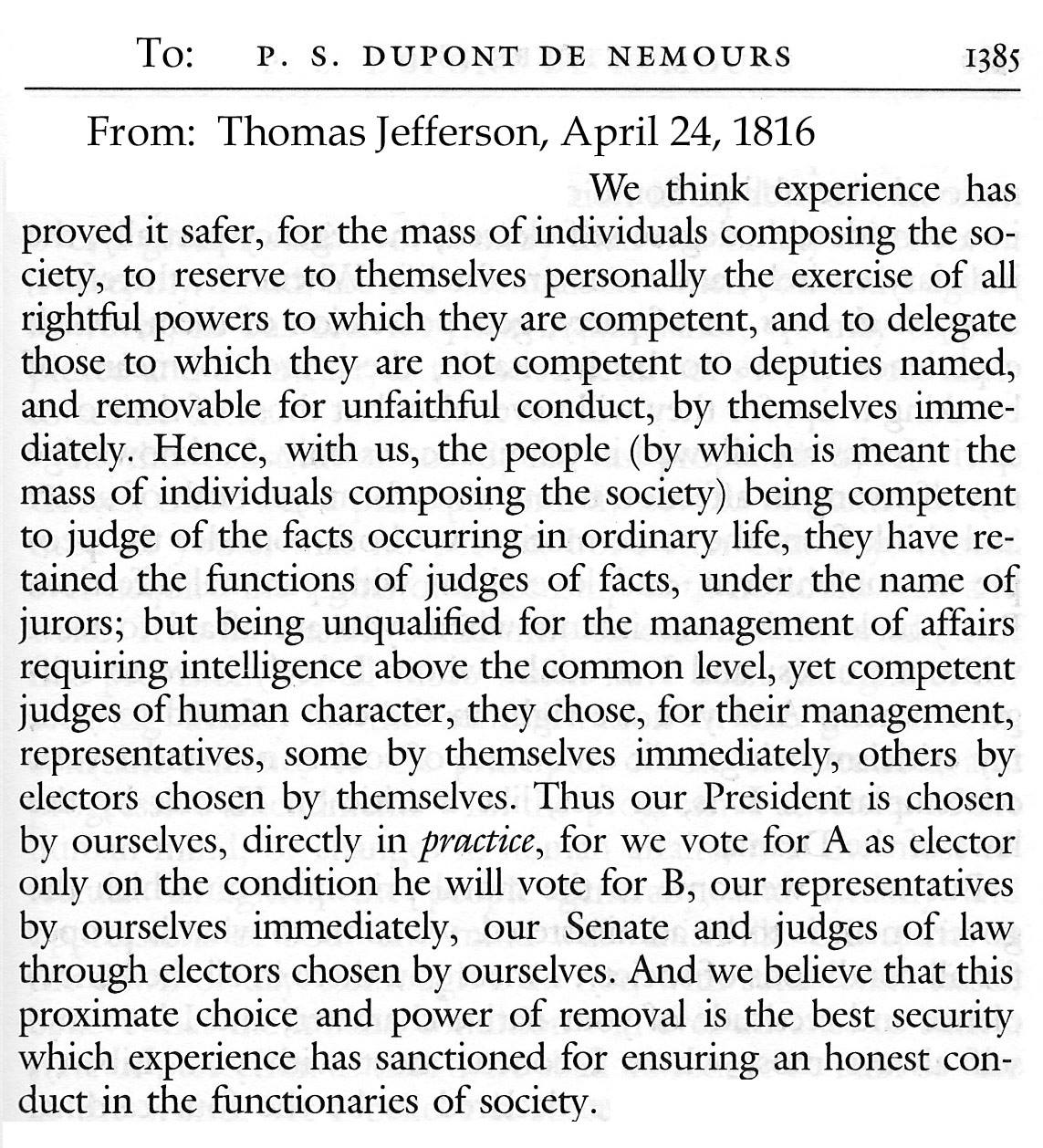
The tension between self-government and “good” government has existed since the origins of modern liberalism. Thinkers such as Herbert Croly and Randolph Bourne staked a claim to a priestly wisdom far greater than that possessed by the ordinary mortal. As Croly explained, “any increase in centralized power and responsibility . . . is injurious to certain aspects of traditional American democracy. But the fault in that case lies with the democratic tradition” and the fact that “the average American individual is morally and intellectually inadequate to a serious and consistent conception of his responsibilities as a democrat.”

During the first two years of the Obama administration, the progressives persuaded themselves that favorable demographics and the consequences of the George W. Bush years would assure the consent of the electorate. They drew parallels with how growing urbanization and Herbert Hoover’s legacy worked for FDR in the 1930s. But FDR enhanced his majority in his first midterm election in 1934; the current progressive agenda, by contrast, was roundly thrashed in 2010. Obama may compare himself to Roosevelt and even to Lincoln, but the electorate does not appear to share this assessment.

After the 2010 thrashing, progressives seemed uninterested in moderating their agenda. Left-wing standard bearers Katrina vanden Heuvel of The Nation and Robert Borosage of the Institute for Policy Studies went so far as to argue that Obama should bypass Congress whenever necessary and govern using his executive authority over the government’s regulatory agencies. This autocratic agenda of enhanced executive authority has strong support with people close to White House, such as John Podesta of the Center for American Progress, a left-liberal think tank. “The U.S. Constitution and the laws of our nation grant the president significant authority to make and implement policy,” Podesta has written. “These authorities can be used to ensure positive progress on many of the key issues facing the country.”

Podesta has proposed what amounts to a national, more ideological variant of what in Obama’s home state is known as “The Chicago Way.” Under that system, John Kass of the Chicago Tribune explains, “citizens, even Republicans, are expected to take what big government gives them. If the political boss suggests that you purchase some expensive wrought-iron fence to decorate your corporate headquarters, and the guy selling insurance to the wrought-iron boys is the boss’ little brother, you write the check.” But the American clerisy isn’t merely a bunch of corrupt politicians and bureaucratic lifers, and the United States isn’t one-party Chicago. The clerisy are more like an ideological vanguard, one based largely in academe and the media as well as part of the high-tech community.

Their authoritarian progressivism—at odds with the democratic, pluralistic traditions within liberalism—tends to evoke science, however contested, to justify its authority. The progressives themselves are, in Daniel Bell’s telling phrase, “the priests of the machine.” Their views are fairly uniform and can be seen in “progressive legal theory,” which displaces the seeming plain meaning of the Constitution with constructions derived from the perceived needs of a changing political environment. Belief in affirmative action, environmental justice, health-care reform, and redistribution from the middle class to the poor all find foundation there. More important still is a radical environmental agenda fervently committed to the idea that climate change has a human origin—a kind of secular notion of original sin. But these ideas are not widely shared by most people. The clerisy may see in Obama “reason incarnate,” as George Packer of The New Yorker put it, but the majority of the population remains more concerned about long-term unemployment and a struggling economy than about rising sea levels or the need to maintain racial quotas.

Despite the president’s clear political weaknesses—his job-approval ratings remain below 50 percent—he retains a reasonable shot at reelection. In the coming months, he will likely avoid pushing too hard on such things as overregulating business, particularly on the environmental front, which would undermine the nascent recovery and stir too much opposition from corporate donors. American voters may also be less than enthusiastic about the Republican alternatives topping the ticket. And one should never underestimate the power of even a less-than-popular president. Obama can count on a strong chorus of support from the media and many of the top high-tech firms, which have enjoyed lavish subsidies and government loans for “green” projects.

If Obama does win, 2013 could possibly bring something approaching a constitutional crisis. With the House and perhaps the Senate in Republican hands, Obama’s clerisy may be tempted to use the full range of executive power. The logic for running the country from the executive has been laid out already. Republican control of just the House, argues Chicago congressman Jesse Jackson, Jr., has made America ungovernable. Obama, he said during the fight over the debt limit, needed to bypass the Constitution because, as in 1861, the South (in this case, the Southern Republicans) was “in a state of rebellion” against lawful authority. Beverley Perdue, the Democratic governor of North Carolina, concurred: she wanted to have elections suspended for a stretch. (Perdue’s office later insisted this was a joke, but most jokes aren’t told deadpan or punctuated with “I really hope someone can agree with me on that.” Also: Nobody laughed.)

The Left’s growing support for a soft authoritarianism is reminiscent of the 1930s, when many on both right and left looked favorably at either Stalin’s Soviet experiment or its fascist and National Socialist rivals. Tom Friedman of the New York Times recently praised Chinese-style authoritarianism for advancing the green agenda. The “reasonably enlightened group” running China, he asserted, was superior to our messy democracy in such things as subsidizing green industry. Steven Rattner, the investment banker and former Obama car czar, dismisses the problems posed by China’s economic and environmental foibles and declares himself “staunchly optimistic” about the future of that country’s Communist Party dictatorship. And it’s not just the gentry liberals identifying China as their model: labor leader Andy Stern, formerly the president of the Service Employees International Union and a close ally of the White House, celebrates Chinese authoritarianism and says that our capitalistic pluralism is headed for “the trash heap of history.” The Chinese, Stern argues, get things done.

A victorious Obama administration could embrace a soft version of the Chinese model. The mechanisms of control already exist. The bureaucratic apparatus, the array of policy czars and regulatory enforcers commissioned by the executive branch, has grown dramatically under Obama. Their ability to control and prosecute people for violations relating to issues like labor and the environment—once largely the province of states and localities—can be further enhanced. In the post-election environment, the president, using agencies like the EPA, could successfully strangle whole industries—notably the burgeoning oil and natural gas sector—and drag whole regions into recession. The newly announced EPA rules on extremely small levels of mercury and other toxins, for example, will sharply raise electricity rates in much of the country, particularly in the industrial heartland; greenhouse-gas policy, including, perhaps, an administratively imposed “cap and trade,” would greatly impact entrepreneurs and new investors forced to purchase credits from existing polluters. On a host of social issues, the new progressive regime could employ the Justice Department to impose national rulings well out of sync with local sentiments. Expansions of affirmative action, gay rights, and abortion rights could become mandated from Washington even in areas, such as the South, where such views are anathema.

This future can already been seen in fiscally challenged California. The state should be leading a recovery, not lagging behind the rest of the country. But in a place where Obama-style progressives rule without effective opposition, the clerisy has already enacted a score of regulatory mandates that are chasing businesses, particularly in manufacturing, out of the state. It has also passed land-use policies designed to enforce density, in effect eliminating the dream of single-family homes for all but the very rich in much of the state.

A nightmare scenario would be a constitutional crisis pitting a relentless executive power against a disgruntled, alienated opposition lacking strong, intelligent leadership. Over time, the new authoritarians would elicit even more opposition from the “dodos” who make up the majority of Americans residing in the great landmass outside the coastal strips and Chicago. The legacy of the Obama years—once so breathlessly associated with hope and reconciliation—may instead be growing pessimism and polarization.

Fred Siegel, a contributing editor of City Journal, is scholar in residence at St. Francis College in Brooklyn. Joel Kotkin is a contributing editor of City Journal and the Distinguished Presidential Fellow in Urban Futures at Chapman University.

Let em drill

Gazette Let Em Drill

Search

Blogroll

Categories

Archives

Meta

Wikio