Same Quality at 1/10th Cost

Oct 31, 2008

by John Goodman

Sundays at the Goodman household tend to include the New York Times crossword puzzle, the Dallas Cowboys football game….and (not to be missed)….an e-mail press release from Health Affairs, describing their latest, most interesting and most newsworthy offerings.

Yet by far the most interesting, informative and valuable article I’ve ever read in Health Affairs didn’t make it into any press release. Nor did it get covered in any of the mainstream health policy media outlets. It was an article about a country with institutions that produce health care quality as good or better than what we have, at a fraction of the cost! It describes how and why this happens and what institutions keep similar innovations from occurring in the United States.

So why the news blackout? Hard to say. As in art, food and sex, perhaps in health policy there’s no way to explain the diversity of human interests.The country is India, where fewer than one in seven people purchase health insurance. Yet two-thirds of Indian households rely on private medical care — a preference that cuts across classes and even extends to rural and paramedic care. Not to put too fine a point on it, but India appears to have the largest free market for medical care found anywhere in the world.
November 2, 2008November 2, 2008
(more…)

Dollars to doughnuts diagnosis

Dollars to doughnuts diagnosis

marginal coverage

Massachusetts Gov. Deval Patrick has been boasting that his state’s health reform initiative has reduced the number of uninsured by half, with nearly 300,000 more people added to the health insurance rolls. What he doesn’t say is that four out of five of them are relying heavily on taxpayer subsidies for their coverage. (more…)

Goodman’s Law

From Liberating The Supply Side by John Goodman 

Ask yourself this question: If Blue Cross were paying all the drug bills, would Rx.com even exist today? Would Wal-Mart be offering $4-a-month prescriptions? Would Publix be giving away antibiotics for free?

The fact that there is the most price competition in the market for drug therapies and the least for hospital therapies is an illustration of Goodman’s Law, which says that innovation and entrepreneurship are inversely proportional to the degree of third-party payment.

Goodman sums it up

“In all of social science - whether economics, politics, sociology, history, etc. - there is only one model that (a) is internally consistent and (b) can explain and predict. That is the model developed by economists. All the rest is gobbledygook. And more often than not, it is highly opinionated, value-laden gobbledygook.”

Economic theory predicts that in any system in which all the actors find it in their self-interest to overuse resources, fail to improve quality and impede access to care, there will be system-wide problems of cost, quality and access. And this prediction holds not just for the United States, it holds for the health care systems of Britain, Canada and other countries as well.

John Goodman

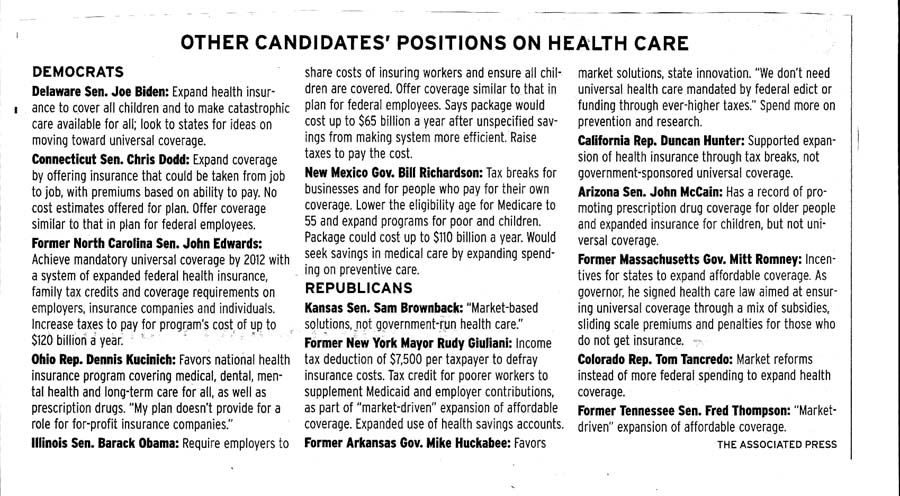
candidate’s health care plans

Other candidate plans

(click image for full size)

And there is the Clinton Health plan.

consumer-driven health care

From: Forbes Commentary             By: Regina Herzlinger
09.04.07, 6:00 PM ET

We have turned over $2.2 trillion of our money to those who manage our health care, without holding them accountable. Not surprisingly, these folks–hospitals, insurers, governments–used the money to benefit themselves.

Insurers, hospitals and governments have gotten fat–our bloated health care costs kill the competitiveness of U.S. firms and more than 40 million people are uninsured, mostly because they cannot afford it–while 300,000 people die every few years from medical errors. Arrogant insurance bureaucrats deny people the services they paid for, while many insured find their coverage inadequate for serious illnesses. The uninsured who are charged the very highest prices by our nonprofit, ostensibly “charitable” hospitals are all too often driven to bankruptcy.

Meanwhile, doctors leave the profession in droves because of insurer, hospital and government micromanagement of their activities. Most of the doctors enrolled in my Harvard Business School M.B.A. courses explain, “I can no longer practice medicine.” The powerful grip of the status quo also scares off the entrepreneurs who represent the best hope of transforming this whale.

Only two stakeholders can fix this–you and I. We must take back our money and we must decide how to spend it. We should be buying health insurance for ourselves, using the foregone salaries and mammoth taxes we once turned over to this self-serving crew. Switzerland’s consumer-driven health care system points the way: The Swiss have universal coverage, spend 40% less and enjoy an excellent, private health care system.

We are in a war for control of $2.2 trillion. If we do not win it, our health and economy will go up in flames.

Regina Herzlinger is the first woman to be awarded tenure at the Harvard Business School as the Nancy R. McPherson Professor of Business Administration. Her new book, Who Killed Health Care? (McGraw-Hill), details the consumer-driven battle plan that can revive our doctors, economy and good health.

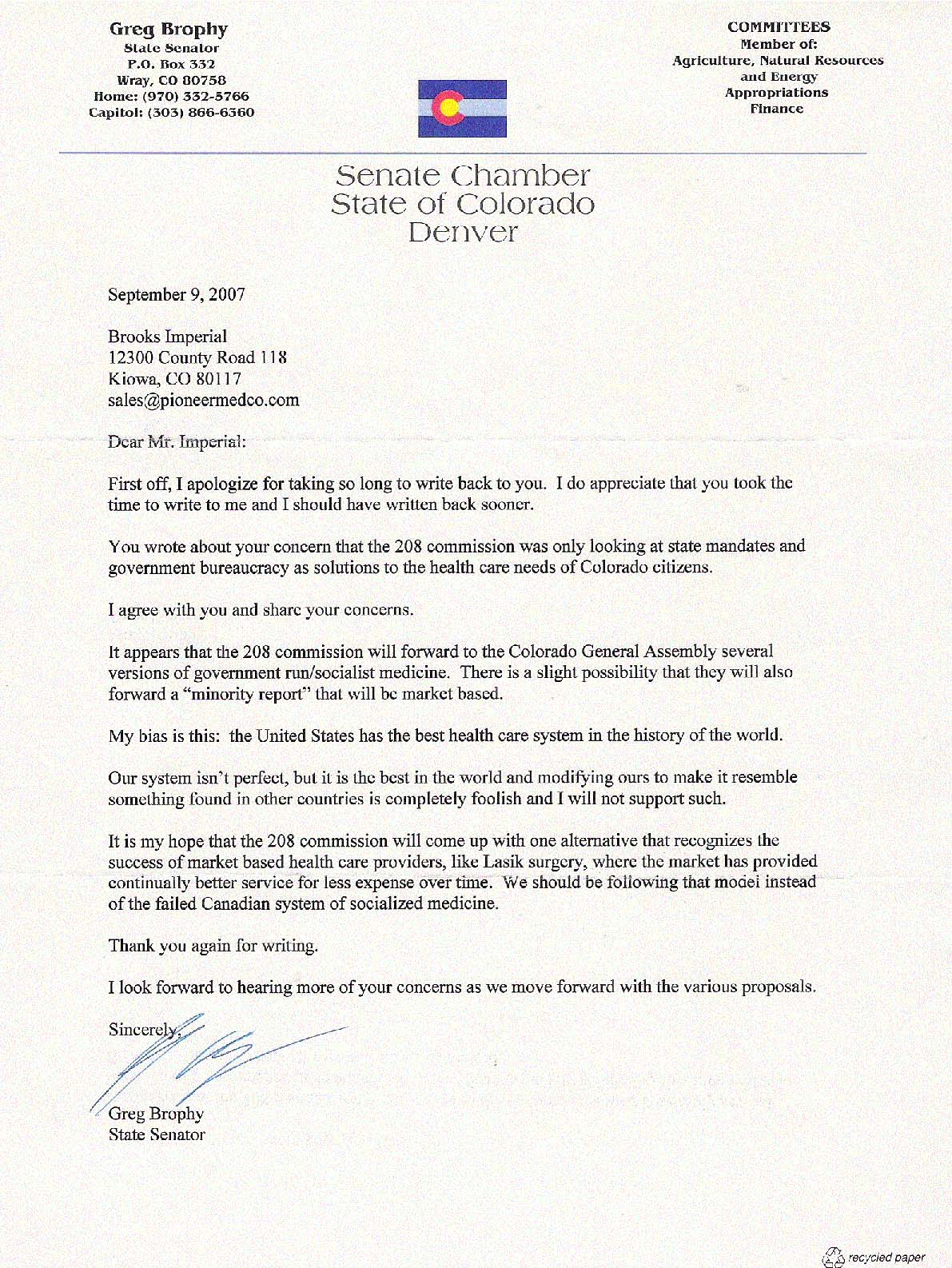
Sen Brophy on 208

(more…)

toll road taboo

(more…)

Lin Zinser on Lewin’s 208

(more…)

208 criteria

(more…)

EMTALA

(more…)

an insurance case

(more…)