health care roundtable

The Future of Health Care in America:
A Roundtable Discussion

Sponsored by the Heartland Institute

Denver Public Library - Central Branch
10 W. Fourteenth Ave. Pkwy.
Denver, CO 80204

Wednesday, March 10, 2010

2:00 pm Opening Remarks and The Rise Of Consumer-Driven Health Care
Peter Fotos, Director of Government Relations, The Heartland Institute

2:30 pm Emerging Issues: Protecting the Doctor/Patient Relationship
Dr. Jill Vecchio, Radiology Oncologist and Colorado Organizer of Docs4PatientCare

3:00 pm The True Cost of Health Care Reform
Dr. Linda Gorman, Director of the Health Care Policy Center, The Independence Institute

3:30 pm An Update from the State of Colorado
State Senator Shawn Mitchell, District 23 of Colorado

4:00 pm A Perspective from the Insurance Industry
Speaker TBD

4:30 pm Free-Market Activities in Colorado
Jon Caldara, President, The Independence Institute

5:00 pm Closing Remarks


There is no registration fee for this event

Please feel free to pass this email along to friends and family, also Government Relations Staffers are encouraged to attend

Please RSVP to Mary,
at 303-279-6536 or rsvp@i2i.org.

not the party of no

GOP Idea Man Charts Course For Solvency

By GEORGE F. WILL
Posted 02/05/2010 06:25 PM ET

In 2013, when President Mitch Daniels, former Indiana governor, is counting his blessings, at the top of his list will be the name of his vice president: Paul Ryan. The former congressman from Wisconsin will have come to office with ideas for steering the federal government to solvency.

Not that Daniels has ever been bereft of ideas. Under him, Indiana property taxes have been cut 30% and for the first time, Standard & Poor’s has raised the state’s credit rating to AAA.

But in January 2010, Ryan released an updated version of his “Roadmap for America’s Future,” a cure for the most completely predictable major problem that has ever afflicted America.

Some calamities — the 1929 stock market crash, Pearl Harbor, 9/11 — have come like summer lightning, as bolts from the blue. The looming crisis of America’s Ponzi entitlement structure is different. Driven by the demographics of an aging population, its causes, timing and scope are known.

Funding entitlements — especially medical care and pensions for the elderly — requires reinvigorating the economy. Ryan’s map connects three destinations: economic vitality, diminished public debt, and health and retirement security.

To make the economy — on which all else hinges — hum, Ryan proposes tax reform. Masochists would be permitted to continue paying income taxes under the current system. Others could use a radically simplified code, filing a form that fits on a postcard.

It would have just two rates: 10% on incomes up to $100,000 for joint filers and $50,000 for single filers; 25% on higher incomes. There would be no deductions, credits or exclusions, other than the health care tax credit (see below).

Today’s tax system was shaped by sadists who were trying to be nice: Every wrinkle in the code was put there to benefit this or that interest. Since the 1986 tax simplification, the code has been recomplicated more than 14,000 times — more than once a day.

At the 2004 Republican convention, thunderous applause greeted George W. Bush’s statement that the code is “a complicated mess” and a “drag on our economy” and his promise to “reform and simplify” it. But his next paragraphs proposed more complications to incentivize this and that behavior for the greater good.

Ryan would eliminate taxes on interest, capital gains, dividends and death. The corporate income tax, the world’s second highest, would be replaced by an 8.5% business consumption tax. Because this would be about half the average tax burden that other nations place on corporations, U.S. companies would instantly become more competitive — and more able and eager to hire.


Medicare and Social Security would be preserved for those currently receiving benefits, or becoming eligible in the next 10 years (those 55 and older today). Both programs would be made permanently solvent.

Universal access to affordable health care would be guaranteed by refundable tax credits ($2,300 for individuals, $5,700 for families) for purchasing portable coverage in any state. As persons under 55 became Medicare-eligible, they would receive payments averaging $11,000 a year, indexed to inflation and pegged to income, with low-income people receiving more support.

Ryan’s plan would fund medical savings accounts from which low-income people would pay minor out-of-pocket medical expenses. All Americans, regardless of income, would be allowed to establish MSAs — tax-preferred accounts for paying such expenses.

Ryan’s plan would allow workers under 55 the choice of investing more than one-third of their current Social Security taxes in personal retirement accounts similar to the Thrift Savings Plan long available to, and immensely popular with, federal employees. This investment would be inheritable property, guaranteeing that individuals will never lose the ability to dispose every dollar they put into these accounts.

Ryan would raise the retirement age. If, when Congress created Social Security in 1935, it had indexed the retirement age (then 65) to life expectancy, today the age would be in the mid-70s. The system was never intended to do what it is doing — subsidizing retirements that extend from one-third to one-half of retirees’ adult lives.

Compare Ryan’s lucid map to the Democrats’ impenetrable labyrinth of health care legislation. Republicans are frequently criticized as “the party of no.” But because most new ideas are injurious, rejection is an important function in politics. It is, however, insufficient.

Fortunately, Ryan, assisted by Republican representatives Devin Nunes of California and Jeb Hensarling of Texas, has become a think tank, refuting the idea that Republicans lack ideas.

http://www.investors.com/NewsAndAnalysis/ArticlePrint.aspx?id=520346

British health system fails

As Congress acts on their leftist mythology to impose nationalized health care on America, the Brits document the folly of their own mistake.

Daily Mail, Saturday, November 28, 2009: 3,000 needless deaths every year

Daily Mail Comment, Saturday, November 28, 2009: Paying the ultimate price for NHS targets

The Daily Telegraph, Saturday, November 28, 2009: Want to fix the NHS? Go private

Senate socializtas

As the Senate considers socialized medicine for the U.S. today, consider what the concentration of government funding for socialized medicine throughout Europe has done for the business of health care.  See Medica 2009 in Dusseldorf.  It’s simply enormous.  Floor space for the 4-day event costs around $20,000 for a 10′ x 10′ square.  That’s $2M for a 100′ x 100′ space.  The opulence is palpable.  Massive displays of every medical device, machine, and product stretch for acres and acres in multiple linked buildings.  Thousands of beautiful women and sharp dressed men represent their products with panache, elan and requisite sex appeal.  The Medica show began around the same time governments began pouring public money into health care in the 60’s and 70’s.  If you want more of something, subsidize it, and the evidence seems beyond doubt that public health care dollars have had this effect.  It is puzzling, however, that the business of health care seems to be doing so well while the actual provision of health care seems to be in a state of crisis and in need of further socialization, more subsidy, and more government control.  Is there really a disconnect here?  Or is the argument for socializing health care in America a myth propagated by a leftist congress intent on perpetrating an extreme device to transfer more wealth and power to government forces?  If the U.S. House and Senate get their way, we’ll definitely get more health care business.  Ironically, we’ll also get health care rationing, scarcity of providers, and enormously increased taxes.  Imagine how our economies would look without governments confiscating enormous wealth and directing it into favored industries, and instead, people directed the spending of their own wealth toward goods and services they actually wanted?  Would we buy these fantastically expensive trade shows?  I seriously doubt it.     pb200230-copy.jpg

government at the people

Dems Go Nuclear

Posted 10/16/2009 07:54 PM ET

Health Care: Democrats seem set to use the “nuclear option” to ram their government health takeover into law. Bipartisanship already looked dead; now it looks extinct.

The health care revolution the Democratic Congress has planned — with its inevitable medical rationing, thousands of dollars in increased insurance premiums, and coverage of illegal aliens — may get placed on the familiar fast track used to spend hundreds and hundreds of billions of taxpayer dollars this year.

Instead of the 60 votes needed in the Senate if proper parliamentary rules were followed, passing this reshaping of the medical system as a “budget reconciliation” measure would mean only a simple majority was needed.

House Ways and Means Committee Chairman Charles Rangel, D-N.Y., accused of cheating on his taxes, last week held a hearing to let the House version of the health reform bill be passed this way. As the Washington weekly Human Events reports, Democratic leaders “have apparently invoked the ‘nuclear option’ to shut out Republicans and ensure the bill is passed before the end of the year.”

So all those “town hells” during the summer, where senators and congressmen were given an earful about passing secretly written thousand-page bills without reading them, will be ignored. (more…)

Coffman’s health care town hall

9/3/09 at Elbert County Public Health building.  About 150 in attendance.

Overview of HB 3200

“Public Option” example in Colorado 

The Overlooked Existing Safety Net 

Things That Can Be Done 

price feedback

No Reform Without Skin In The Game
By PAUL D. TORTLAND | Posted Thursday, August 27, 2009 4:20 PM PT

The scenario is all too familiar, and plays out daily in my office. After evaluating a patient I recommend a particular course of treatment. More often than not, the first question from the patient is not, “How effective is the treatment?’ or “How safe is it?” Rather, the refrain is “Will my insurance cover it?” If I tell them, yes, your insurance will cover the treatment, their eyes glaze over and they couldn’t care less what their care will cost. If, on the other hand, the procedure is not covered, the bargaining begins: “Do you give cash discounts?” “Can I set up a payment plan?” Or, “That’s too much right now.”

It’s easy to spend someone else’s money. It’s a different story when your wallet is on the table. (more…)

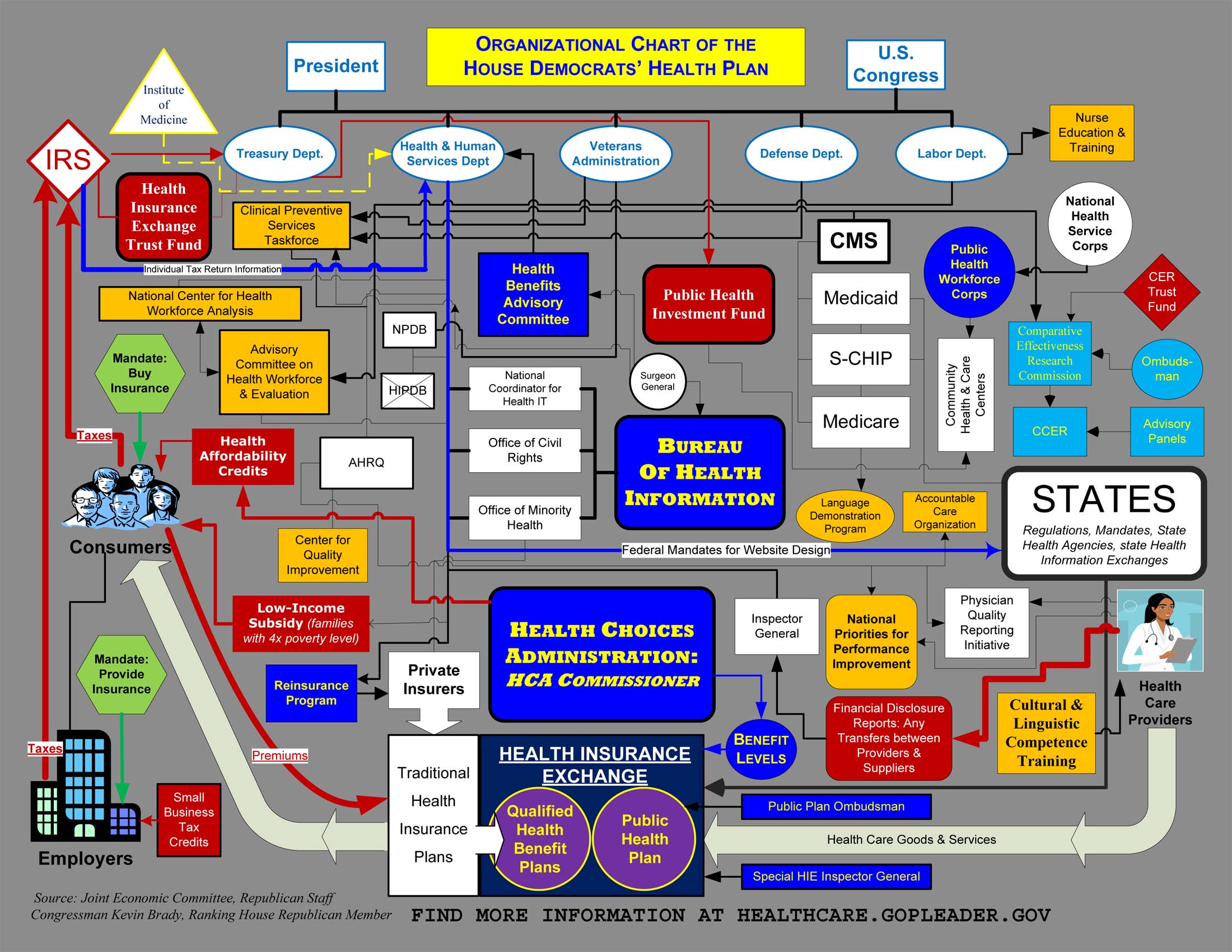
bureaucracy care

click to enlarge
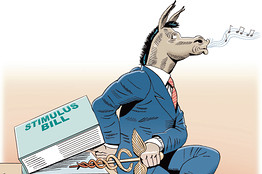
House Democrats Health Plan

CautionDon’t get sick.

health care debate we SHOULD have

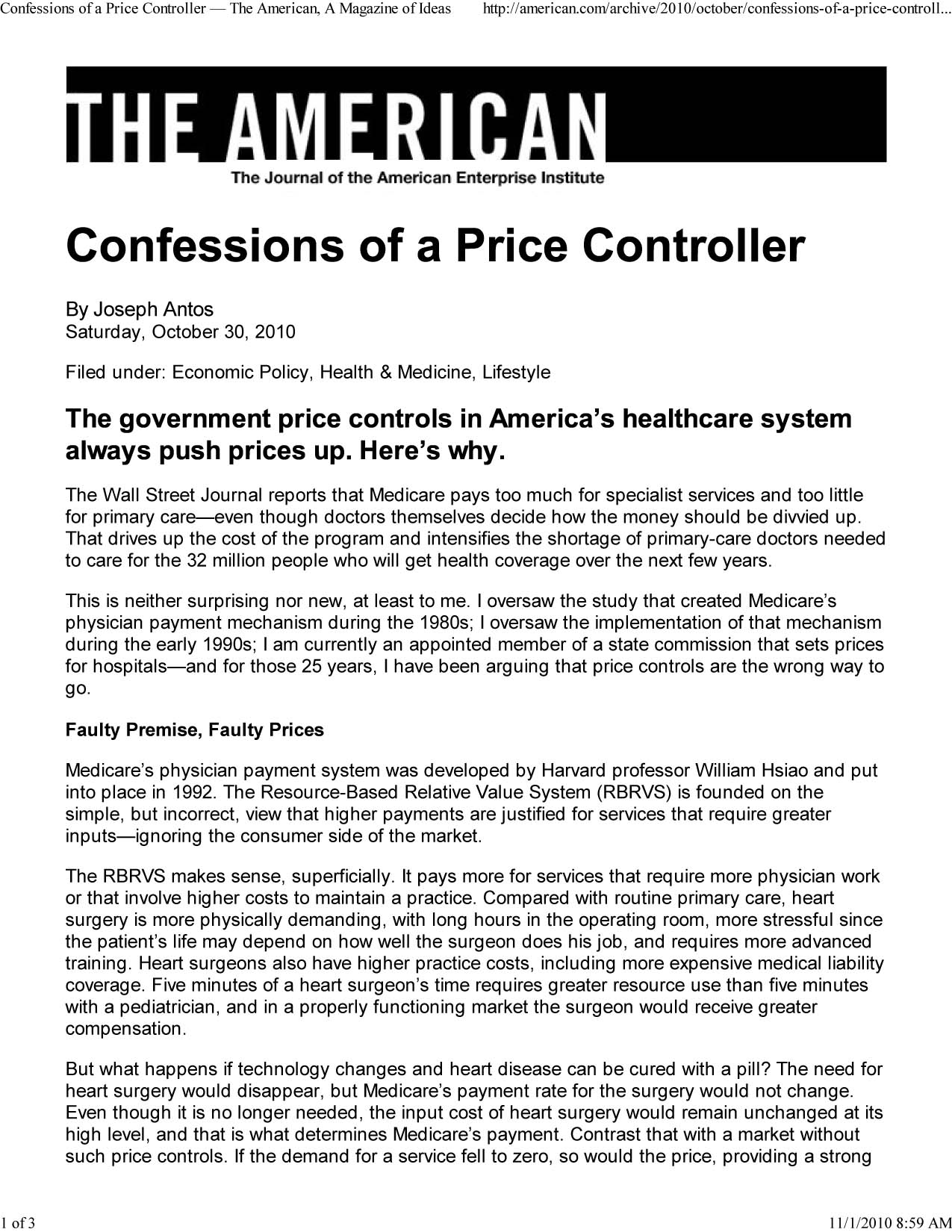
In America, government fixes all Prices (called “fee schedules”) for health care devices, drugs, services, and procedures that are provided with public money (Medicare, Medicaid, Social Security, the VA, etc.)  The private insurance market also uses these government fixed prices, but usually at a discounted rate–still price fixing, just at a discount.

Health care price-fixing happens at the political nexus where interest groups and lobbyists meet legislators and regulators.  These politics do not yield the sort of equilibrium you get with the market forces of supply and demand.  No one involved in establishing these price points actually has to pay for what they’re pricing.  Therefore the demand element of this health care pricing mechanism is a fiction.  Prices that come out of this process will only randomly reflect what real supply and demand would, and will only randomly be rational.

Meanwhile, legislators and regulators do not operate in a vacuum.  They get ALL of their demand side pricing information from a) providers and b) insurance companies.  They get ALL of their supply side pricing information from a) providers, b) insurance companies and c) manufacturers.

No inputs to health care price-fixing come from the actual consumers of health care, and the consumers of health care are the ONLY element in the health care market who are CAPABLE of providing real demand information–because they are the ones who actually pay for it!

To summarize, providers want higher health care prices because they earn more money that way.  Insurance companies want higher health care prices because they earn more money on more expensive products and services.  Manufacturers want higher health care prices because they earn more money for their goods.  And legislators and regulators are disinterested third parties who exist to be persuaded to control price points, where all the persuasion comes from parties who have an interest in higher price points.

This is the debate we should be having.  Any proposed structural change to our health care market that does not address what fundamentally controls the price of health care in America will not materially improve matters.

Our current system of health care pricing is disconnected from consumers and can only result in a poor allocation of health care to meet real needs.  This is what we have today.  If we don’t change this, we will never optimize the provision of health care, with the cost of health care, and with a rational price for that health care.

Government price fixing causes shortages–an economic fact of life whether the object is gasoline or health care.

a crock

Our old crock pot gave up the ghost after 20 years and we bought a new one.  I’m still counting the improvements in crock pot technology that 20 years of free market competition yielded for less money than the original.

  • a slim oval design
  • glass lid with vent holes
  • ergonomic lid handle with a spoon carrier
  • built-in silicon lid gasket
  • transport clips for locking the lid down for trips to pot lucks
  • removable spoon drip tray
  • bracket for holding the hot lid which also spins around to provide a cord wrap structure
  • easily cleanable aluminum housing
  • lighter weight heating element
  • flip up silicon handles for secure handling
  • 3 stage heating element

No doubt these many improvements did not come from one source.  They came about from multiple innovations by many companies competing to win customers in the free crock pot market.

Imagine how many of these innovations would not have occurred in a government-controlled crock pot market.  Imagine how the absence of competition coupled with the presence of federal oversight and regulation would have cemented that 20 year-old crock pot design into our culture.

Consider the medicare-subsidized and fda-regulated health care industry in America, or the new federally-managed American automobile industry.  Consider driving a 50-year-old Chevy on the island of Cuba.

Governments don’t adapt very well.  It’s not in their nature.

The problem with the left’s legislative agenda for America, which they seem unable to adequately describe in less than a thousand pages of federal spaghetti-legalize, is we’ll never know all of the wonderful human products, behaviors, solutions, and creativity that they preclude from coming into existence.

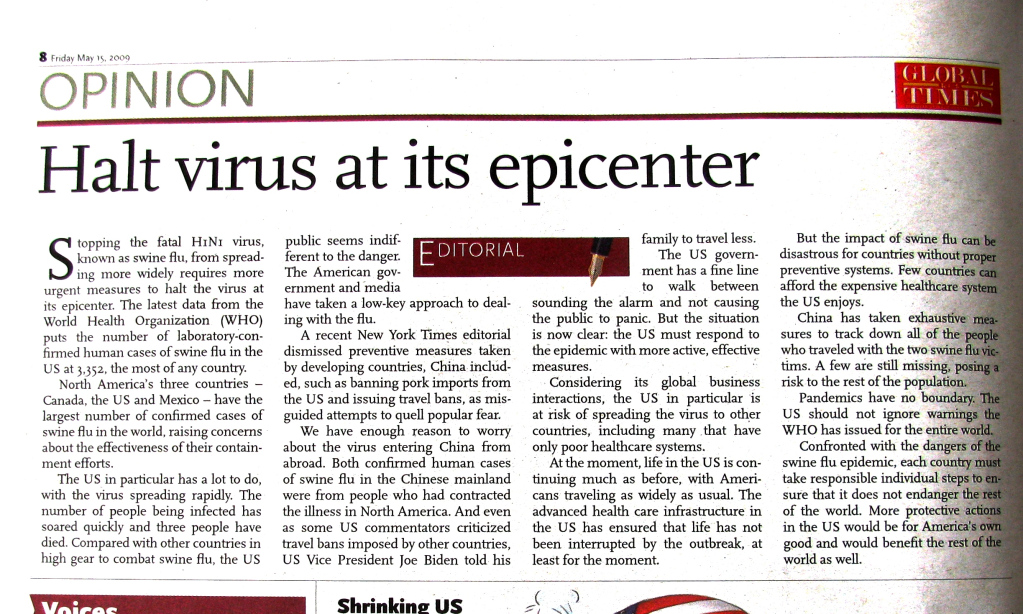
global times guilt

The Global Times is the voice of the Chinese government.

“The advanced health care infrastructure in the US has ensured that life has not been interrupted by the outbreak, at least for the moment.  But the impact of swine flue can be disastrous for countries without proper preventive systems.  Few countries can afford the expensive healthcare system the US enjoys. . . .More protective actions in the US would be for America’s own good and would benefit the rest of the world as well.”

It would seem the expensive healthcare system Americans “enjoy” serves America’s “own good” better than a guilt-trip from the Global Times.  This is a teaching-moment for all those countries who “enjoy” socialized medicine.

(click to enlarge)

Global Times Editorial


“We have not yet understood that to subsume our world under the concept of “capitalism” is already to enter into the dichotomous worldview of ideology.” Alain Besancon

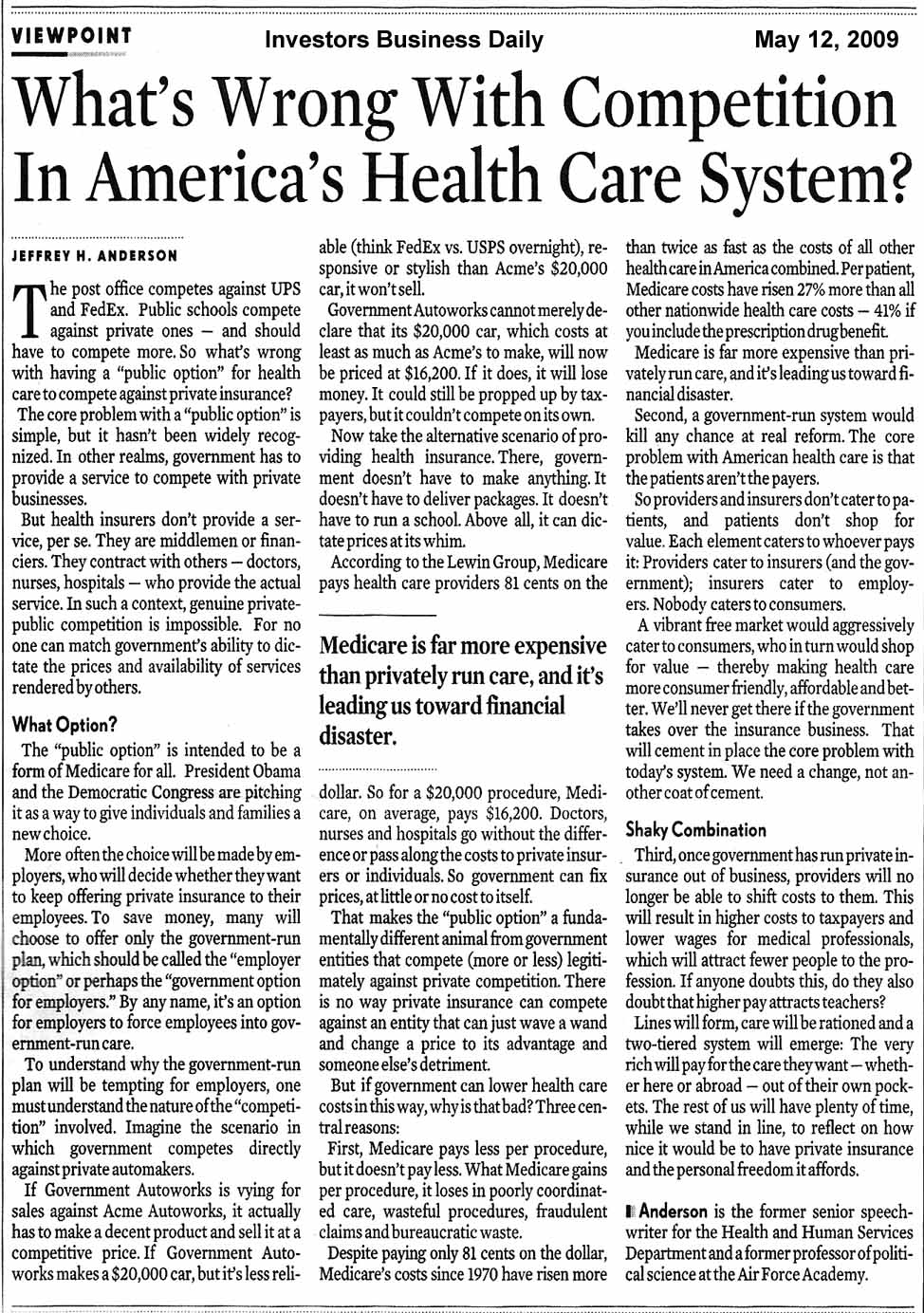
health care competition

Health Care Competition

blowback

“Because white guilt is a vacuum of moral authority, it makes the moral authority of whites and the legitimacy of American institutions contingent on proving a negative: that they are not racist.  The great power of white guilt comes from the fact that it functions by stigma, like racism itself.  Whites and American institutions are stigmatized as racist until they prove otherwise. . . . .[T]he larger reality is that white guilt leaves no room for moral choice; it does not depend on the goodwill or the genuine decency of people.”  Shelby Steele, White Guilt, 2006.

The moral authority that comes from an absence of moral choice is actually no moral authority.  This is a prescription for endless manipulation–by both blacks and whites–which Steele documents at length.  He also wrote, (more…)

Health Status Insurance

Health-Status Insurance
How Markets Can Provide Health Security
by John H. Cochrane

Act I

(click to enlarge)
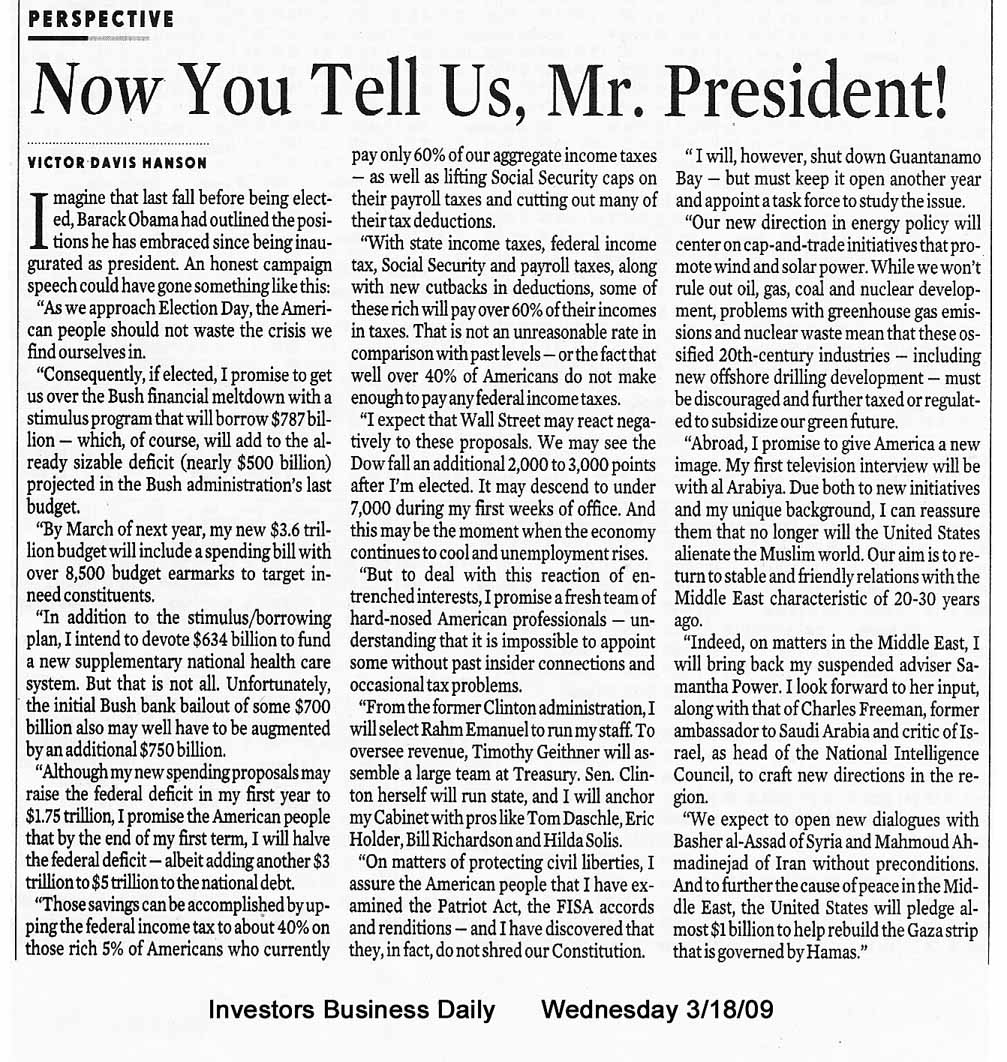
Now You Tell Us, Mr. President

May we have an Intermission now?  I need a couple drinks before Act II starts.

Search

Blogroll

Categories

Archives

Meta